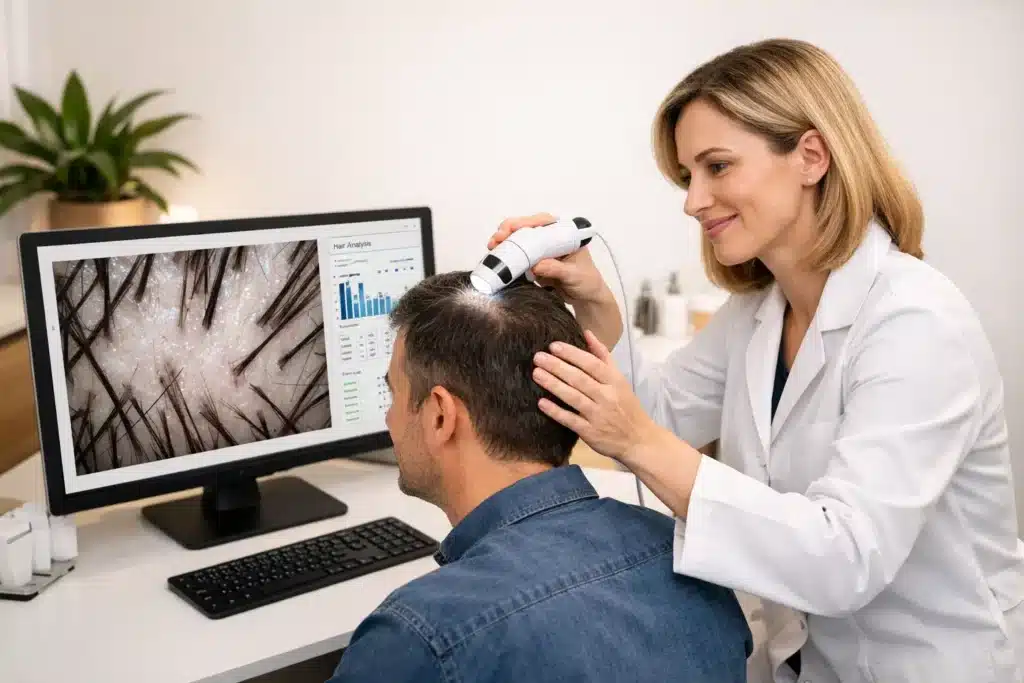
The 12-Month Struggle That Could Have Been Two Weeks
Picture a full year spent battling what you think is stubborn dandruff. Twelve different shampoos, three home remedies found online, and a growing suspicion that the problem might be “untreatable.” Then, finally, an appointment with a dermatologist.
The examination takes minutes. The diagnosis is seborrheic dermatitis with secondary folliculitis, and with the right treatment, symptoms like these can settle within weeks.
This familiar story illuminates a critical gap in scalp healthcare: the vast difference between self-diagnosis and professional assessment. Recent dermatology practice studies document exactly how significant this gap is — and what it costs patients in time, money, and wellbeing.
The Numbers Don’t Lie: Time to Resolution
A comprehensive analysis of patient outcomes published in dermatology literature reveals stark differences in treatment timelines:12
Why Professional Assessment Works So Much Faster
1. Accurate Diagnosis from Day One
The Pennsylvania Dermatology Specialists note that “many scalp conditions are mistaken for simple dandruff, but there are key differences.”1 Professional examination identifies the actual condition rather than assuming “it’s just dandruff,” eliminating months of trial and error.
Research documented specific cases where professional evaluation proved essential:1
“A dermatologist diagnosed seborrheic dermatitis and created a treatment plan that resolved the symptoms within weeks.”
“Another patient experienced hair thinning and scalp redness. A biopsy confirmed psoriasis, and early intervention prevented significant hair loss.”
2. Targeted Treatment Instead of Guessing
Over-the-counter products use a “broad spectrum” approach, hoping to address multiple potential causes. Professional diagnosis enables targeted treatment that addresses the specific problem.
3. Prevention of Progressive Worsening
Perhaps most crucially, professional diagnosis prevents conditions from worsening whilst patients experiment with ineffective treatments. The dermatology literature emphasises: “Relying solely on shampoos can delay proper care and exacerbate the issue.”1
During months of self-treatment, conditions can:
- Spread to other areas (face, ears, chest)
- Develop secondary infections
- Cause irreversible hair follicle damage
- Progress from acute to chronic inflammation
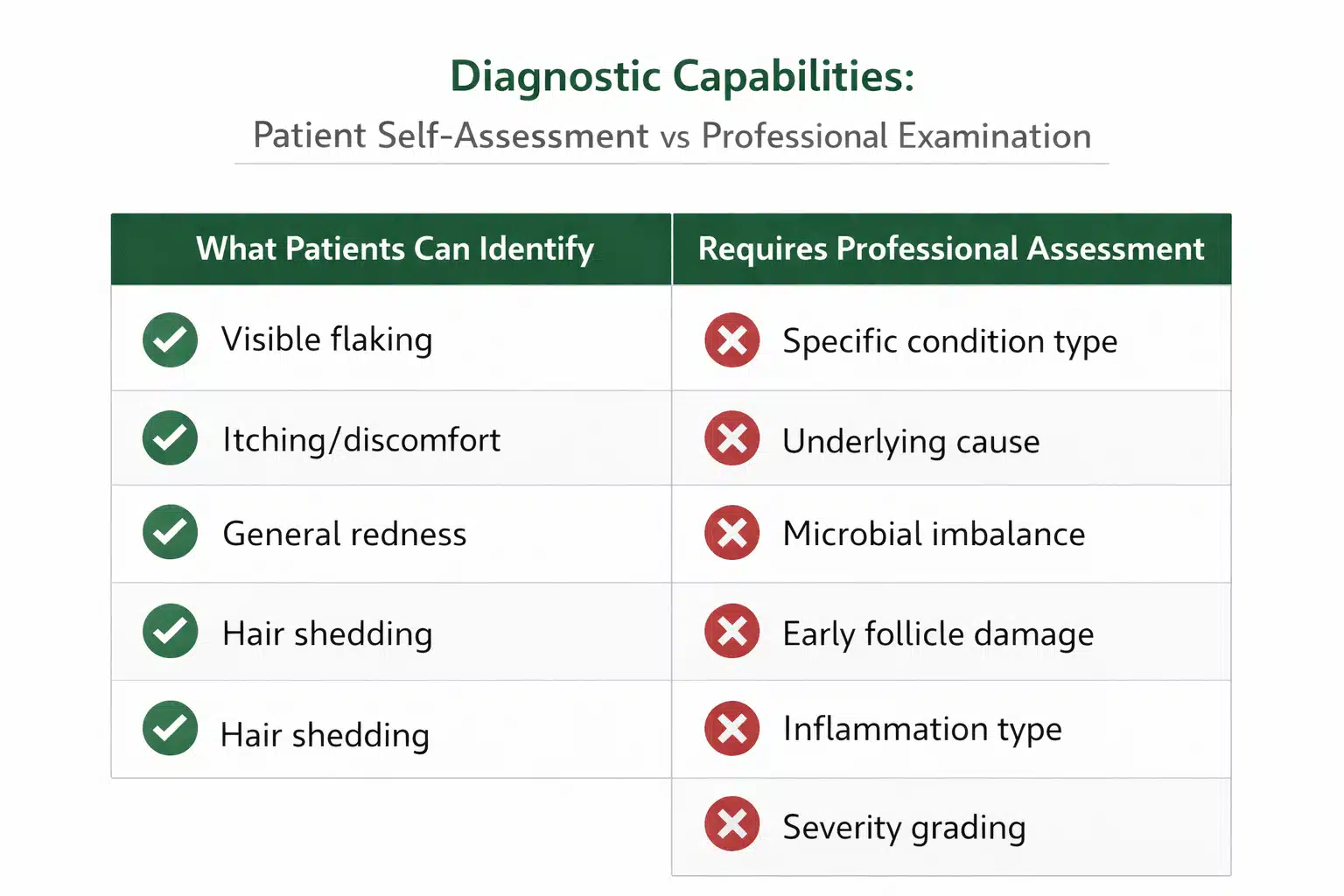
What Professional Assessment Reveals That You Can’t See
Modern professional scalp assessment goes far beyond what’s visible to the naked eye.4
Advanced Diagnostic Tools
Modern trichoscopy provides capabilities impossible with naked eye examination:5
- High-Magnification Imaging: 200x magnification reveals microscopic details
- AI-Powered Analysis: Identifies patterns across thousands of data points
- Objective Measurement: Follicle density calculations, inflammation quantification
- Progress Tracking: Documents subtle changes over time with precision
The Cost of Delay: More Than Just Time
The gap between self-treatment and professional diagnosis costs patients more than just months of discomfort.
Quality of Life Impact
Research in the Journal of Clinical and Aesthetic Dermatology documents the significant impact of scalp conditions on quality of life:6
- Social confidence: Visible flaking affects social interactions
- Sleep disruption: Itching interferes with rest
- Self-esteem: Chronic scalp issues impact self-image
- Stress: Ongoing unsuccessful treatment creates anxiety
The Diagnosis Gap: Why People Wait So Long
Barrier 1: Assumption It’s “Just Cosmetic”
Many people view scalp issues as beauty concerns rather than health issues. As one dermatologist notes: “Salon professionals are often the first line of defence when it comes to common scalp issues.”7
Barrier 2: Hope the Next Product Will Work
The availability of numerous OTC options creates an endless cycle of “maybe the next one will work.” Each new product represents hope, delaying the recognition that professional help is needed.
Barrier 3: Lack of Awareness
Many people simply don’t know that professional scalp assessment is an option. They assume dermatologists only handle severe conditions.
Barrier 4: Cost Perception
Ironically, people often spend more on ineffective OTC products than a professional assessment would cost — but the upfront cost of professional help seems higher.
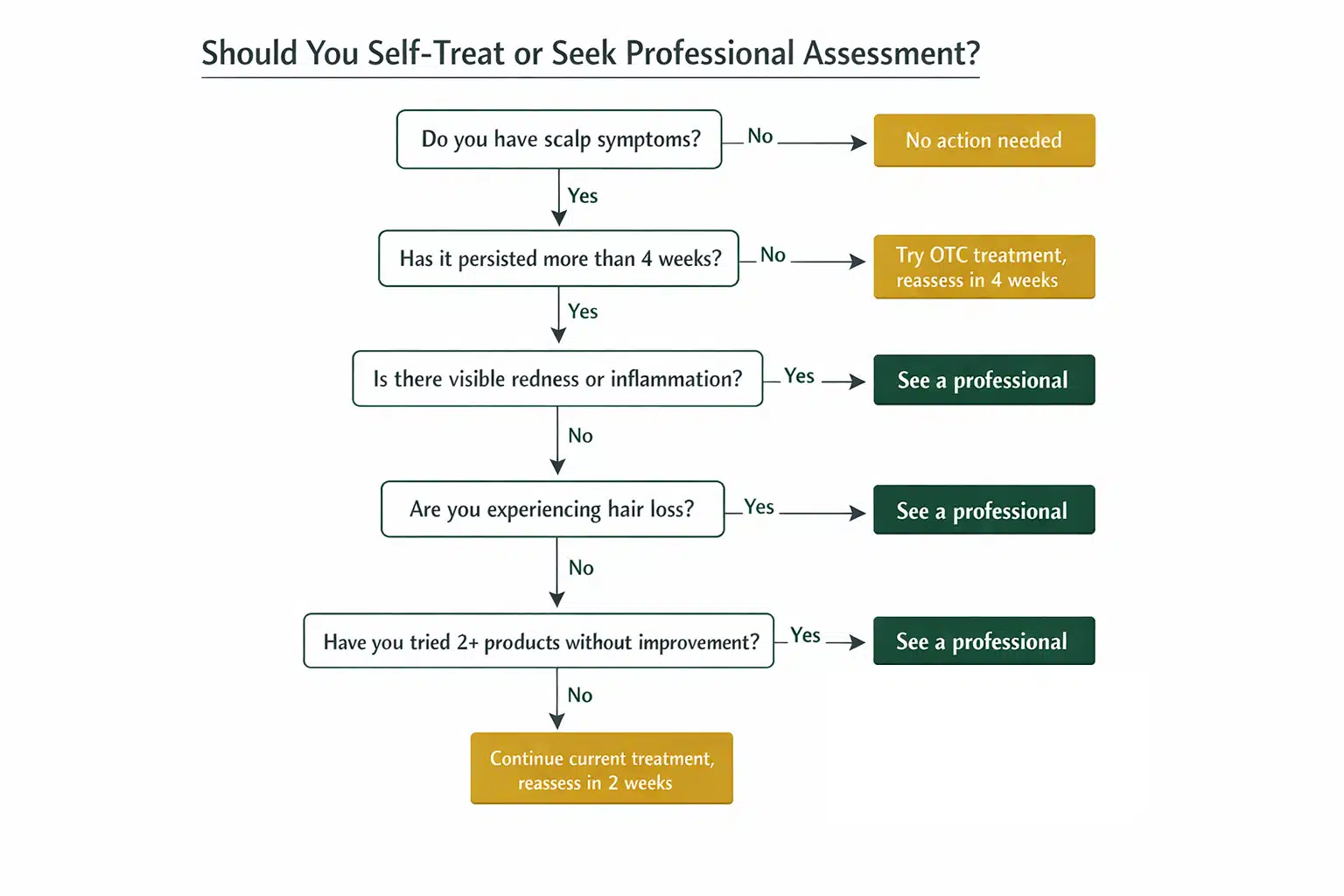
When to Skip Self-Treatment and Go Straight to a Doctor
Based on dermatology practice guidelines, you should see a GP or dermatologist promptly if:18
Red Flag Symptoms
- Heavy or greasy flaking (not just light, dry flakes)
- Visible redness or inflammation
- Symptoms affecting areas beyond scalp (face, ears, chest)
- Concurrent hair loss or thinning
- Intense itching disrupting sleep or daily activities
- Persistent symptoms despite 2-4 weeks of consistent OTC treatment
What Happens During a Dermatology Appointment
Understanding the process removes mystery and encourages a timely appointment. A scalp assessment typically covers:
- History: Medical history review, symptom discussion, lifestyle factors
- Visual Examination: Systematic scalp inspection, scale and inflammation assessment
- Magnified Imaging (where available): Trichoscopy, multiple area capture, baseline establishment
- Diagnosis & Treatment Plan: Clear explanation, visual evidence, specific treatment protocol
The Modern Advantage: Technology Enhances Professional Assessment
Today’s professional scalp assessment goes beyond what was possible even five years ago:
- AI-Powered Analysis processes thousands of data points and identifies patterns invisible to human eye alone
- Digital Documentation provides high-resolution images for tracking improvement over time
- Evidence-Based Protocols ensure treatment plans are based on the latest research
The Bottom Line: Guessing Versus Knowing
The research is conclusive: when a scalp problem keeps coming back, an assessment by a GP or dermatologist is often the quicker way to the right care.2 This isn’t about medical gatekeeping — it’s about the fundamental difference between guessing and knowing.
When you self-treat, you’re essentially conducting an experiment with an n of 1, no control group, and limited ability to observe results. When you seek professional assessment, you’re accessing decades of medical training, diagnostic technology, and evidence-based protocols.
Your Action Plan
- Document your journey: What symptoms? What have you tried? What helped?
- Stop the trial-and-error: Each unsuccessful product is another month delayed
- See a GP or dermatologist: Consider it an investment, not an expense
- Request modern diagnostics: Ask about trichoscopy if available
- Follow the protocol: Once diagnosed, adhere to professional recommendations
- Track objectively: Monitor improvement with photos and symptom diary
The difference between 12 months of frustration and 2 weeks of resolution often comes down to one decision: choosing professional assessment over continued self-experimentation. Your scalp — and your hair — deserve that choice.
References
- Pennsylvania Dermatology Specialists. (2025). Signs Your Scalp Health Needs a Dermatologist. Read article
- Borda, L. J., & Wikramanayake, T. C. (2015). Seborrheic Dermatitis and Dandruff: A Comprehensive Review. J Clin Invest Dermatol. Read study
- Gupta, A. K., et al. (2024). Seborrheic Dermatitis. StatPearls. Read resource
- Starace, M., et al. (2006). Clinical diagnosis of common scalp disorders. J Invest Dermatol Symp Proc. Read study
- Litaiem, N., & Zeglaoui, F. (2022). Trichoscopy. StatPearls. NCBI. Read resource
- Blume-Peytavi, U., et al. (2011). Hair Growth and Disorders. J Clin Aesthet Dermatol.
- Beauty Launchpad. (2021). Tips for Identifying and Treating Common Scalp Issues. Read article
- American Academy of Dermatology. (2025). Scalp Psoriasis: Diagnosis and Treatment. Read resource