Type “AI hair analysis” into any search bar and you will find apps promising to scan a photo and tell you exactly what is wrong with your scalp. Some of that promise is real. Some of it is marketing running ahead of the science. The honest answer sits in between, and understanding where that line falls is the difference between using these tools well and expecting something they were never built to do.
How does AI analyse hair or scalp photos?
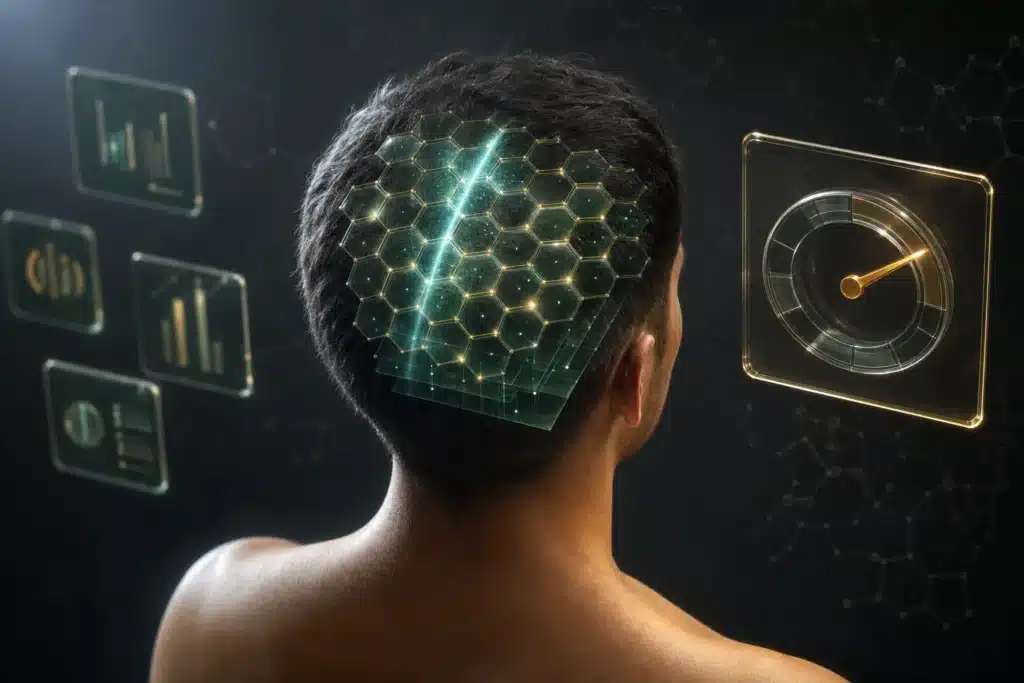
AI hair analysis works by breaking a photo down into measurable features, like the ratio of visible scalp to hair coverage, then comparing those features against patterns learned from thousands of annotated images. It is not “looking” at your scalp the way a clinician does. It is doing pixel-level maths.
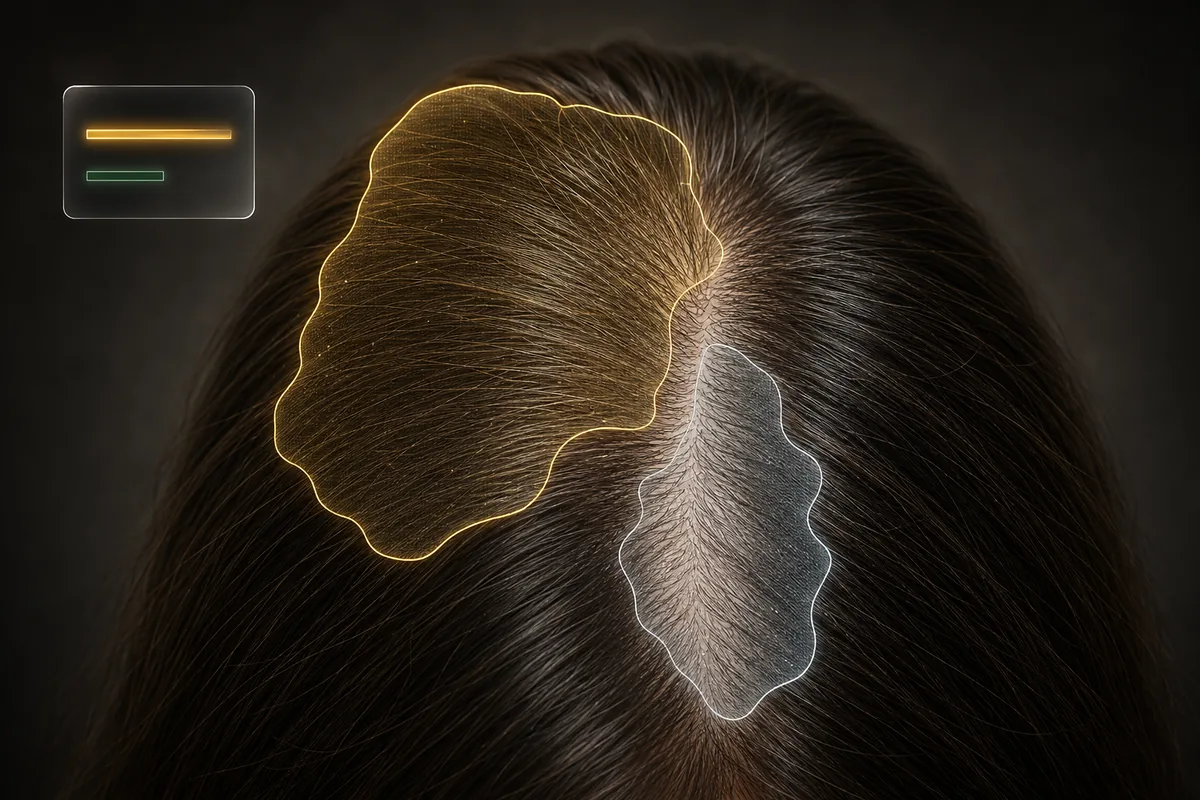
Most current systems use a type of model called a convolutional neural network, trained to detect and segment regions of an image. In practice, that means the model draws a boundary around areas of visible scalp versus areas of hair coverage, then calculates a ratio between the two.1 Some approaches go further, using instance segmentation to separate hair-covered and hair-loss regions with pixel-level precision, then quantifying the proportion between them as an objective severity score.1
None of this involves the model “understanding” hair loss the way a person does. It is closer to a very fast, very consistent measuring tool than a diagnostic mind.
What can AI hair analysis actually get right?
This is where the technology genuinely earns its place. A 2026 review of commercially deployed AI hair analysis tools, evaluating platforms used across professional trichology and hair restoration practice, found that current systems are being used for pattern classification, treatment planning support, and progress monitoring, with growing evidence for their reliability in these narrower tasks.5
The accuracy numbers back this up. One 2025 study using an area-based segmentation model achieved 97.6% average precision in identifying hair loss regions, with the model’s severity classification agreeing closely with dermatologist assessments across most grades of male pattern hair loss.1 A separate deep learning framework trained specifically to predict classification categories in androgenetic alopecia reached roughly 90% accuracy when cross-validated against expert grading.3
Perhaps the more interesting finding is not how good the AI is, but how inconsistent the human comparison point can be. The same 2025 study noted that dermatologists themselves achieve only 65 to 78% reproducibility when staging hair loss using the standard Norwood-Hamilton scale, meaning two experts examining the same scalp can genuinely disagree.1 A consistent, repeatable AI measurement is not competing against a perfect human benchmark. It is competing against a benchmark that is itself known to vary.
What’s the difference between a hair tracking app and a diagnosis?
A diagnosis identifies a cause. A hair tracking app identifies a pattern. Those are genuinely different tasks, and the gap between them is largely a matter of physical resolution and clinical context, not effort or ambition.
Consumer camera systems, even high-resolution ones, cannot resolve follicular structures smaller than roughly 200 micrometres. That puts precise measurements like individual hair shaft miniaturisation, which typically ranges from 20 to 50 micrometres, structurally out of reach without specialised trichoscopic equipment.1 This is not a software problem that better AI will eventually solve. It is a limit set by the optics of a standard camera versus a dedicated magnification device.
There is a second, quieter limitation: photo consistency. Research comparing consumer smartphone images against clinical reference photography found that smartphone and tablet images show systematically different colour and exposure characteristics compared to a calibrated clinical camera, with colour differences exceeding the threshold considered clinically reliable by five to six times.4 This is why the same photo, taken in different lighting or at a different angle, can look meaningfully different even when nothing about your scalp has actually changed. It is also why consistency, same spot, same light, same distance, matters more for tracking accuracy than the megapixel count of your phone.
Can an app actually tell you what’s wrong with your scalp?
No, and any tool that claims to should be treated with caution. What AI hair analysis is genuinely built to do is identify patterns associated with change over time, not diagnose the underlying cause of that change. Distinguishing between, for example, androgenetic thinning and a temporary shedding episode from stress or diet still depends on clinical context an app cannot gather from a photo alone, things like family history, recent illness, medication, and a physical examination.
This is a well-documented limitation across consumer health AI generally, not something unique to hair. Reviews of AI-powered skin analysis apps, a closely related field, consistently frame these tools as screening aids best used alongside professional expertise, not as a replacement for it, since a photo cannot take a medical history or perform a hands-on exam.5
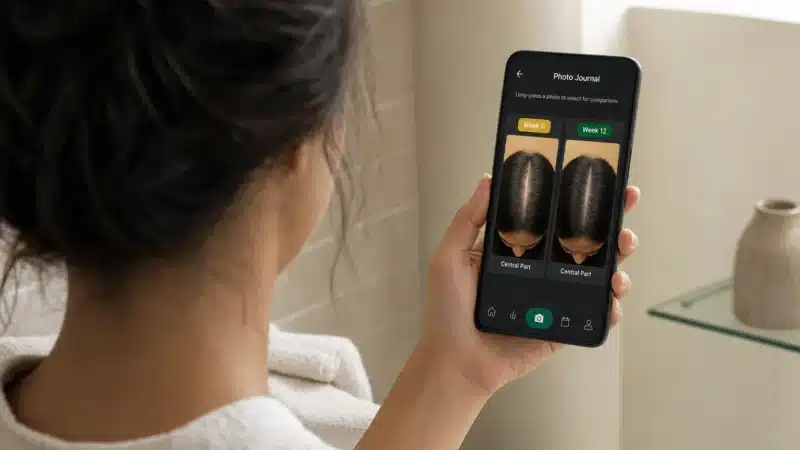
Where this leaves a well-built app is as a way to keep track, not a verdict. Scalp Score, the app from Orga Hair, works that way. Your free Scalp Score is an estimate worked out on your phone from five short questions, not a measurement of your hair, and the Photo Journal keeps your own photographs in order so you can compare them later. Scalp Score Pro, a one-off purchase in Google Play, is an AI analysis of the photographs your answers call for, normally two or three scalp zones, read with your profile.
It is worth being clear that this is not the kind of model described above. Scalp Score Pro uses a general-purpose AI model from Anthropic, given written instructions; nothing was trained for it, and it does not measure your photographs the way those research models do. It describes what your answers and photographs show, in a five-part report (Today, Where, Why, Plan, Watch), and it says what it could not assess. It does not diagnose; if something worries you, a GP or dermatologist is the right next step.
Where AI hair analysis is heading
The direction of travel is toward better explainability, not just better accuracy. Newer models increasingly use techniques that visualise which parts of an image actually drove a given result, making the process less of a black box and more of a transparent measurement you could, in principle, check for yourself.2 That transparency matters more than raw accuracy scores, because it is what lets a professional trust and interpret an AI-generated pattern reading rather than simply accept or reject it.
The resolution ceiling is also moving, slowly. Researchers building today’s AI frameworks are already proposing multi-region analysis and integration with proper trichoscopic parameters as the next step, precisely because they recognise the current gap.1 None of that changes what these tools can responsibly claim today. It just means the honest answer to “what can AI hair analysis tell you” is likely to keep expanding, carefully, rather than arriving all at once.
Frequently Asked Questions
Is there a way to track hair loss progress over time without going to a clinic?
Yes, consistent photo and symptom tracking between clinical visits can capture meaningful change, though it works best as a complement to periodic professional evaluation, not a replacement for it.
How does AI analyse hair or scalp photos compared to a dermatologist?
AI measures pixel-level patterns with high consistency, while a dermatologist brings clinical history and physical examination, each strong in different, complementary ways.
Can a hair tracking app replace a trichoscope?
No, resolution limits mean camera-based apps cannot capture individual hair shaft detail the way a dedicated magnification device can.
References
- Xi, H., Yuan, X., Yuan, H., Lin, K., Wang, C., & Wang, Z., & Zhang, J. (2025). Enhanced stratification of male pattern hair loss using AI through novel loss region ratio analysis. Scientific Reports, 15, 38280. Read study
- Trichoscopy and Computational Models for Hair and Scalp Disorders: Image Analysis, Quantification, and Clinical Integration. (2026). Applied Sciences, 16(7), 3199. Read study
- Deep Learning-based Trichoscopic Image Analysis and Quantitative Model for Predicting Basic and Specific Classification in Male Androgenetic Alopecia. (2022). PubMed Central. Read study
- Region-Specific Calibration Achieves Excellent Inter-Device Reliability for Smartphone Dermatology: A Multi-Device Benchmark on Korean Facial Skin. (2026). arXiv preprint. Read preprint
- Nawaz, T., Williams, G., & Yoo, J. (2026). Exploring the Advancements and Applications of AI-Powered Hair Analysis Tools. Journal of Clinical and Aesthetic Dermatology, 19(2), 58-62. Read study