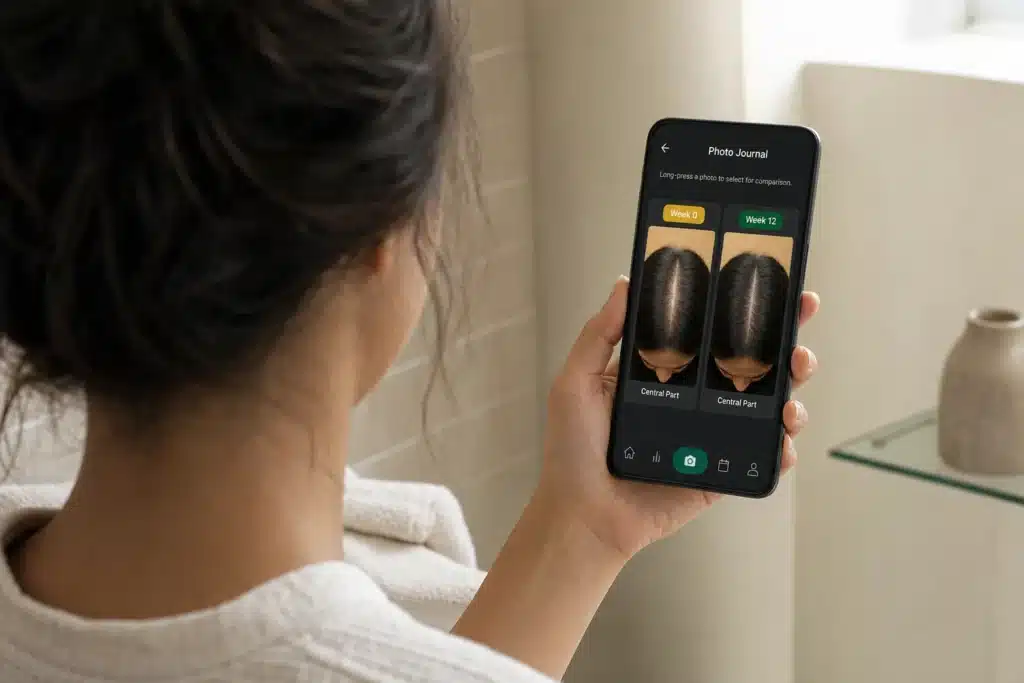
Hair loss is slow. Most people lose density gradually, over months and years, long before it becomes something a mirror check or a quick glance in the bathroom will reveal. That gap between “actually changing” and “visibly different” is bigger than most people assume, and it is the entire reason home tracking exists as a category.
Is there a way to track hair loss progress over time without going to a clinic?
Yes. Consistent photo tracking, symptom logging, and biomarker monitoring at home can capture meaningful change between clinical visits, and in some respects can catch it earlier than an occasional in-person check ever could. The key word is consistent. A single photo tells you almost nothing. The same photo taken the same way, repeatedly, over weeks and months, becomes real data.
This is not a fringe idea. Standardised clinical photography is increasingly recognised inside dermatology itself as central to monitoring hair loss properly, not just a nice-to-have. Research on standardised photography protocols found that photographic assessment improves follow-up rates in patients being treated for androgenic alopecia and alopecia areata, and helps both patients and physicians compare therapeutic effects over time in a way memory alone cannot.1
What can home tracking apps actually capture well?
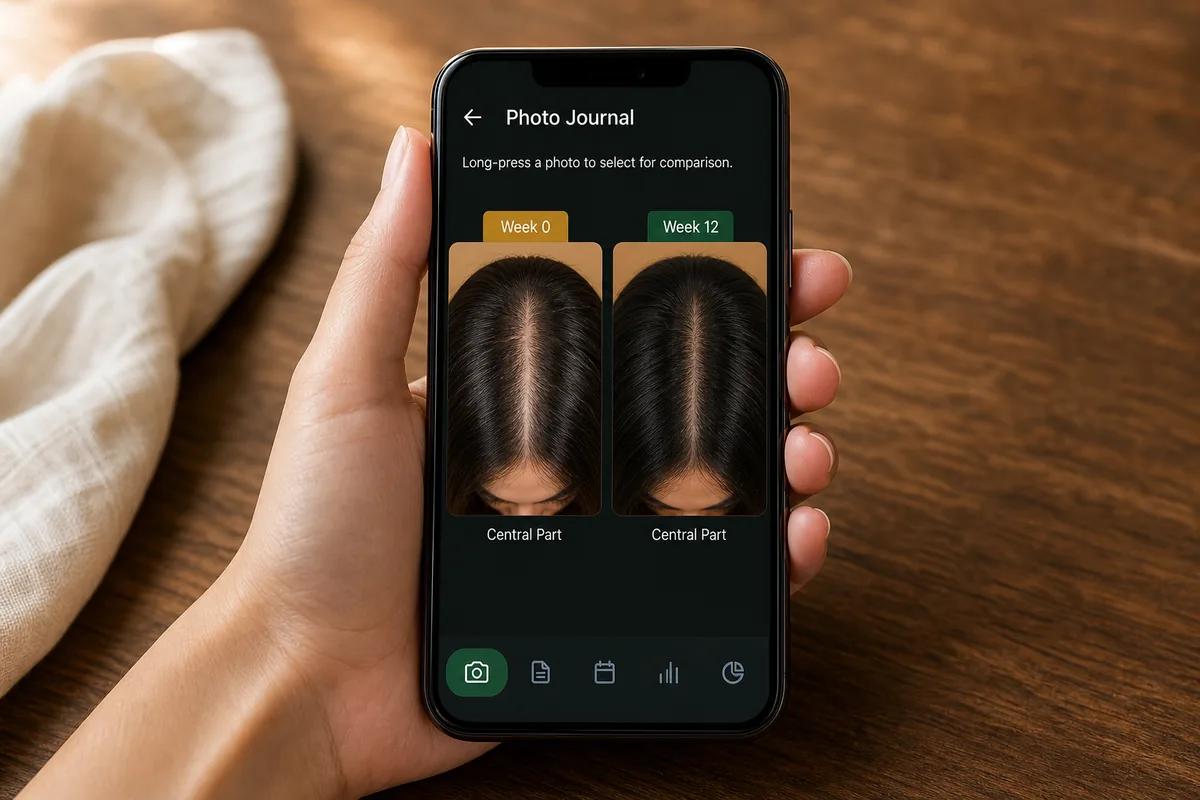
Consistency, mostly, which turns out to matter more than people expect. The same study that examined clinical photography practices found that even inside an academic dermatology department, only 32% of randomly sampled hair loss patients had properly standardised tracking photos before a training intervention was introduced.1 After staff were trained on a simple standardised protocol, that number rose to 66%.1 In other words, even trained clinical staff, with the right equipment on hand, routinely fall short of consistent tracking without a deliberate process in place. A home tracking app that reliably prompts the same angle, same lighting, same interval, every time, is solving a real and surprisingly common problem, not a hypothetical one.
How much hair do you have to lose before a doctor can actually see it?
More than most people would guess. Research examining what minimum degree of hair loss is needed before it becomes identifiable found that a reduction of roughly 22.66% of hair on standardised photographs is necessary before 75% of dermatologists can reliably detect the change at all.1 That is not a criticism of dermatologists, it reflects a genuine limit of visual assessment. Human eyes are simply not well suited to spotting a gradual 10% or 15% decline against a baseline they only saw once, months earlier.
This is the gap consistent tracking is meant to help with. If change only becomes visible to the naked eye once close to a quarter of density has gone, a record kept the same way from early on gives you something to compare against, rather than relying on memory, and something concrete to bring to a GP or dermatologist.
What does home tracking structurally miss?
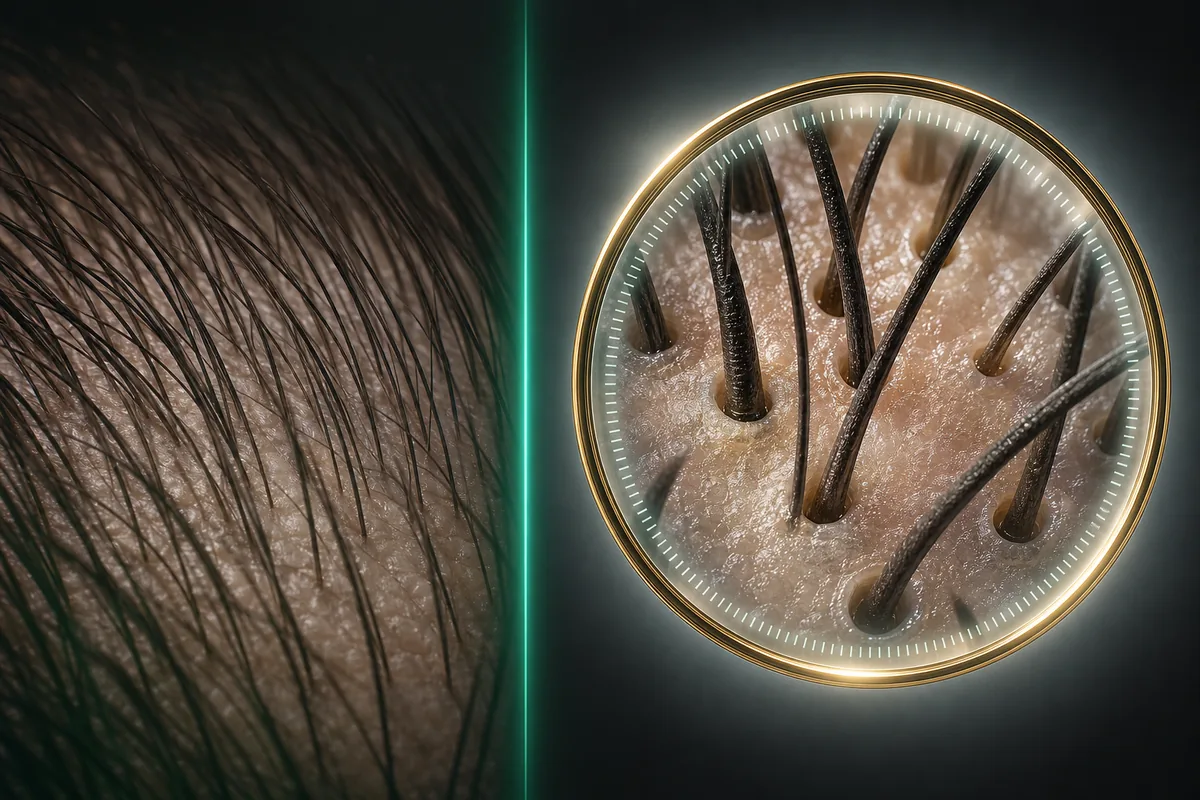
Two things, and they are both real limitations, not marketing caveats. First, magnification. Trichoscopy, examination of the scalp using a manual or digital dermoscope, can magnify up to 1000 times, compared to standard photography, which provides no meaningful magnification at all.2 That level of detail lets a clinician examine individual follicular openings, hair shaft characteristics, and scalp surface features that a photo, however consistent, simply cannot resolve. Standard photography is explicitly described in the clinical literature as functioning best as an adjunct tool rather than a stand-alone method, and as less precise once hair loss is below roughly 50%, since subtle change is genuinely difficult to discern from photos alone at that level.2
Second, remote assessment for hair loss specifically is still an underused and under-studied area. A systematic review of teledermatology in alopecia found that hair loss made up only a tiny fraction, 0.06%, of all the teledermatology visits studied, even though remote consultation for other skin conditions is well established.3 Where teledermatology has been used for hair loss, macro imaging tools and handheld microscopes have enabled some of the same detail a manual dermoscope would catch, hair shaft variability, broken hairs, follicular openings, but the review’s own authors note that further research is needed to establish clear guidelines specifically for hair loss monitoring.3 This is a field still catching up to its own potential, not a settled, solved problem.
The case for tracking between visits, not instead of them
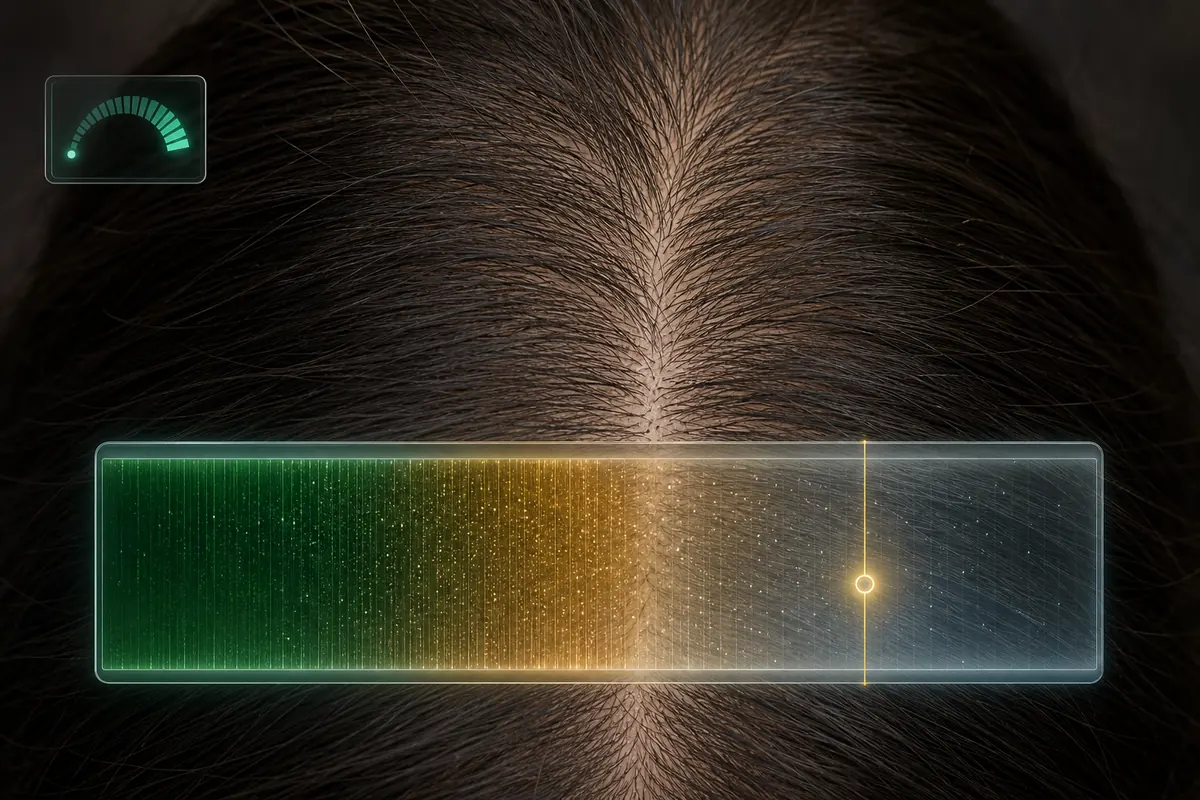
None of this argues against home tracking. It argues for using it correctly, as the connective tissue between periodic clinical anchor points, not a replacement for either. The field itself is actively working on this problem, not treating it as solved, a large 2026 study developing a new hair density grading scale, built from over 1,600 participants and more than 6,600 standardised images, was explicitly motivated by the fact that existing classification systems’ accuracy is, in the researchers’ own words, undesirable.6 Combined with the well-documented reliability issues in visual staging generally,4 the honest conclusion is that no single method, home or clinical, is complete on its own.
The most useful model pairs the two. Consistent tracking at home gives you a record of gradual change, kept the same way over time, to bring to a doctor. A periodic clinical visit, with proper trichoscopic magnification, provides the structural detail and clinical context that no photo, however well tracked, can substitute for.
Frequently Asked Questions
Can an app actually tell you what’s wrong with your scalp?
No. An app can help you keep track of change consistently, but working out the underlying cause still needs a GP or dermatologist.
Is home tracking as accurate as a clinic visit?
They measure different things well. Home tracking excels at consistency and frequency, a clinic visit provides magnification and clinical context home tracking cannot replicate.
How often should I track at home if I’m not seeing a clinician regularly?
Consistency matters more than frequency, the same conditions repeated regularly builds a far more useful record than occasional, inconsistent check-ins.
References
- Rose, K., et al. (2025). Standardization of Clinical Photos for Tracking Management of Hair Loss in Dermatology Clinics. Journal of Cosmetic Dermatology. Read study
- Imaging Tools for Noninvasive Hair Assessment. Cutis. Read study
- Teledermatology in alopecia: A systematic review. (2023). JAAD International. Read study
- Guarrera, M., & Rebora, A. (2009). Reliability of Hamilton-Norwood classification. International Journal of Trichology. Read study
- Xi, H., Yuan, X., Yuan, H., Lin, K., Wang, C., & Wang, Z., & Zhang, J. (2025). Enhanced stratification of male pattern hair loss using AI through novel loss region ratio analysis. Scientific Reports, 15, 38280. Read study
- Development of a New Grading Scale for Evaluating Overall Hair Density. (2026). Journal of Cosmetic Dermatology. Read study