
You have tried minoxidil. You have done PRP. You take the supplements, use the shampoo, sleep eight hours, eat well — and still, when you look in the mirror, nothing appears to have changed. If this sounds familiar, you are probably not failing your treatments. Your treatments may simply have no way to tell you whether they are working.
This is the paradox at the centre of hair loss management for millions of people: the more interventions you add, the harder it becomes to know what any of them are doing. Effort and clarity are moving in opposite directions. And the longer this continues, the heavier the burden becomes — not just logistically, but psychologically.
Why We Stack Treatments — And Why It Feels Right
When hair loss feels urgent, doing more feels like the responsible response. If minoxidil alone seems insufficient, adding PRP makes intuitive sense. If PRP has not produced visible results, red light therapy becomes the next logical layer. Each treatment is clinically recognised. Each is supported by at least some evidence. The impulse to combine them is not irrational — it is the natural response to a condition that carries significant emotional weight.
Research consistently documents the psychological burden of androgenetic alopecia. A widely cited study examining hair loss and quality of life found that the condition profoundly affects self-esteem, body image, and emotional wellbeing — particularly in women — with anxiety driving continued treatment-seeking behaviour even when outcomes remain unclear.1 The instinct to keep adding is not a character flaw. It is a predictable and entirely human response to distress.
The problem is not the individual treatments. The problem is what happens to your ability to evaluate them once they are all running at the same time.
The Scientific Problem: When You Cannot Isolate a Variable, You Cannot Learn From It
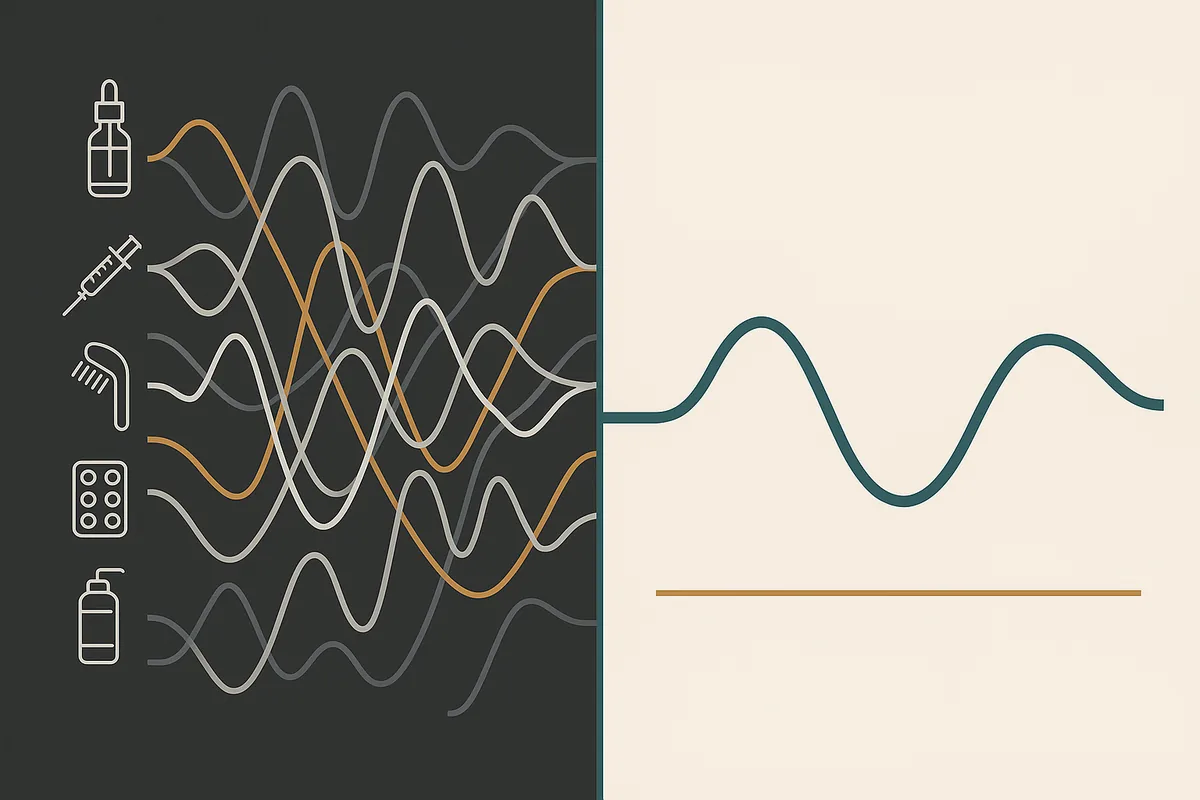
In clinical research, isolating variables is the foundation of drawing any meaningful conclusion. It is why randomised controlled trials exist: to ensure that when a result occurs, you know what caused it. When you run six interventions simultaneously without a documented baseline, you have inadvertently created a personal experiment with no control group, no primary endpoint, and no mechanism for reading its results.
If your hair density improves over the next six months, which treatment drove it? If it worsens, which one is failing — or interacting negatively with another? If nothing measurably changes, is that because every treatment is underperforming, or because several are producing subclinical progress that the mirror simply cannot detect?
This is not a hypothetical problem. Research into N-of-1 trial methodology — the application of controlled experimental design to individual patient protocols — has consistently found that without structured measurement, self-directed treatment stacking produces data that is clinically uninterpretable.2 The treatments may be doing something. The difficulty is that without an instrument sensitive enough to measure it, you have no way to know.
What the Research Actually Says About Treatment Timelines
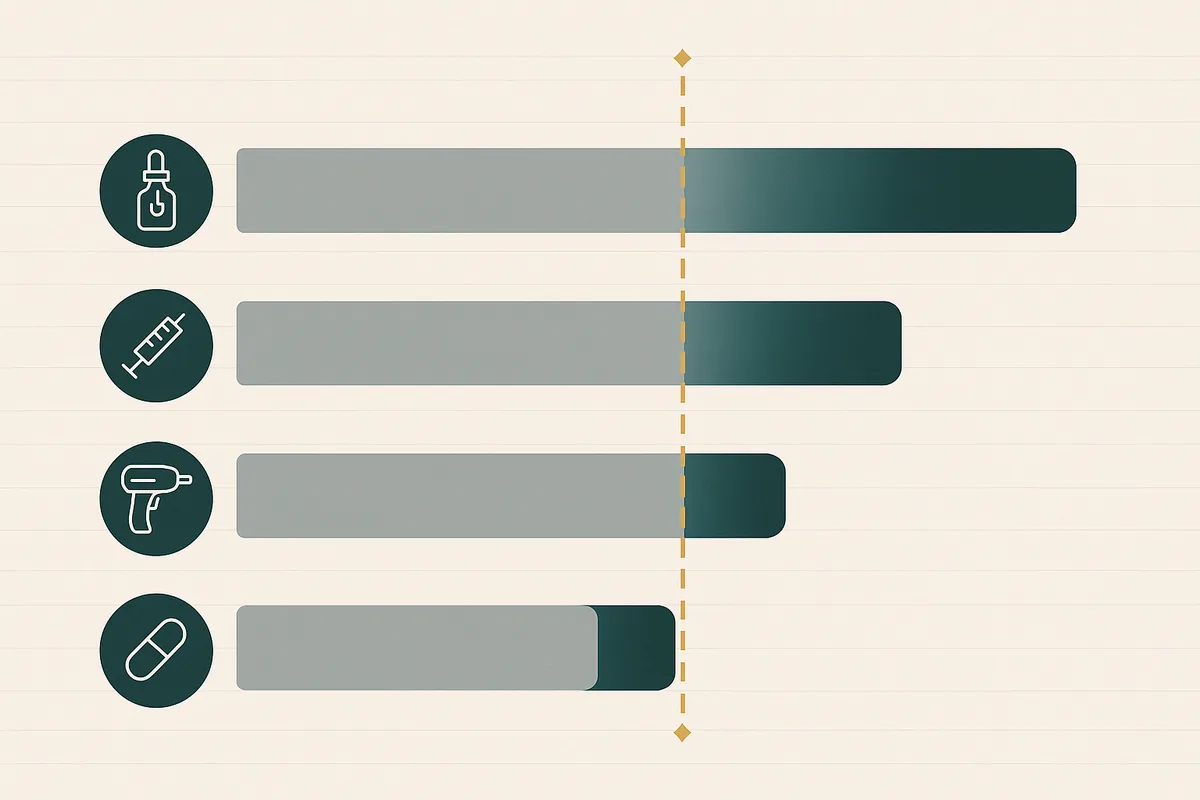
Part of the frustration driving treatment accumulation is a mismatch between expectation and evidence-based timelines. Most people abandon or layer treatments based on what they can — or cannot — see in the mirror. The mirror, however, is a poor instrument for follicular biology.
Oral minoxidil, one of the most extensively studied interventions for androgenetic alopecia, requires a minimum of six months before measurable density changes are typically detectable, with the most robust evidence for response documented at nine to twelve months of consistent use.3 Platelet-rich plasma therapy, reviewed across multiple randomised controlled trials, shows statistically significant improvement in hair density at the four-to-six month mark — but not reliably before it.4 Low-level laser therapy demonstrates measurable follicular response in controlled studies at sixteen to twenty-six weeks of consistent application.5
None of these windows are intuitive. None of them are visible to the naked eye at the point most people decide something is not working. And when all three are running simultaneously, even a positive eventual result cannot be attributed to any one of them with any confidence.
The Hidden Cost of Carrying Everything at Once
There is a dimension to treatment stacking that clinical literature rarely addresses directly: the weight of it. Not simply the financial cost, though that is real. The cognitive and emotional load of maintaining multiple concurrent protocols — managing dosages, attending appointments, monitoring ambiguous outcomes, sustaining hope across an undefined timeline — is itself a significant stressor. And stress is a well-documented variable in hair follicle biology.
Evidence suggests that chronic psychological stress may influence the transition of hair follicles from the growth phase into the shedding phase in susceptible individuals, with cortisol implicated as a key mediator of this disruption.6 The burden of an unresolved treatment question is not a neutral backdrop to recovery. In certain cases, it may be an active variable in the condition itself.
This is not an argument for abandoning treatment. It is a recognition that the structure surrounding treatment matters as much as the treatments themselves — and that structure begins with measurement.
What a Lighter Approach Actually Looks Like

The alternative to treatment stacking is not doing less. It is measuring with greater precision. And the entry point to that is a documented baseline established before — or alongside — any treatment protocol.
Trichoscopic imaging, the clinical standard for objective scalp and follicle assessment, can identify patterns associated with changes in follicle miniaturisation, hair shaft diameter distribution, and scalp condition at a resolution the mirror cannot approach.7 When a baseline is established at the outset, every subsequent measurement has a reference point. Progress that is invisible to the naked eye becomes legible in the data. A treatment that appears not to be working may show subclinical change — or may clearly not be contributing, allowing it to be removed from the protocol without guesswork or guilt.
This is what structured longitudinal tracking changes: not the treatments themselves, but your capacity to have a meaningful conversation with what they are doing. Instead of carrying six unresolved questions simultaneously, you carry one clear data trail — and the questions begin to answer themselves over time.
A trichoscopic baseline is something a dermatologist can take. The home half of the record is yours to keep, and Scalp Score, the Orga Hair app, is built to help with it. Five short questions give you a free Scalp Score straight away, with no sign-up — an estimate that moves when your answers change. The Photo Journal keeps your own photographs of the same scalp zones in date order, so you can compare them side by side, and the wash-day check-in keeps a note of how your scalp felt. It does not measure density, diagnose or prescribe, and it does not tell you which treatment is working. It helps you keep track. And in the absence of objective data, documentation is the most useful tool available to anyone navigating a long-term treatment journey.
If you have been doing everything and still feel as though you are getting nowhere, the most important question is not what else should I add — it is what does the data actually show?
References
- Williamson D, Gonzalez M, Finlay AY. The effect of hair loss on quality of life. J Eur Acad Dermatol Venereol. 2001;15(2):137–139. Read study
- Punja S, Xu D, Schmid CH, et al. N-of-1 trials can be aggregated to generate group mean treatment effects: a systematic review and meta-analysis. BMJ Open. 2016;6(4):e010271. Read study
- Randolph M, Tosti A. Oral minoxidil treatment for hair loss: A review of efficacy and safety. J Am Acad Dermatol. 2021;84(3):737–746. Read study
- Gupta AK, Carviel JL. Meta-analytical comparison of platelet-rich plasma therapy with 5% minoxidil and finasteride for the treatment of androgenetic alopecia. J Cutan Aesthet Surg. 2017;10(3):130–138. Read study
- Jimenez JJ, Wikramanayake TC, Bergfeld W, et al. Efficacy and safety of a low-level laser device in the treatment of male and female pattern hair loss. Am J Clin Dermatol. 2014;15(2):115–127. Read study
- Thom E. Stress and the hair growth cycle: cortisol-induced hair growth disruption. J Drugs Dermatol. 2016;15(8):1001–1004. Read study
- Lacarrubba F, Dall’Oglio F, Rita Nasca M, Micali G. Videodermatoscopy enhances diagnostic capability in some forms of hair loss. Am J Clin Dermatol. 2004;5(3):205–208. Read study