
You just received your blood test results. The numbers are on the page, each one printed alongside a laboratory reference range telling you whether it is normal. Those reference ranges are calibrated to detect disease or deficiency at a clinical threshold — they were not designed to assess your hair follicle health.
For most markers, the difference between the laboratory’s “normal” and the range the trichology literature considers meaningful for hair cycling is significant. Ferritin flagged normal at 18 ng/mL by a lab reads differently against the ranges the hair research literature discusses. The same is true for vitamin D, TSH, and several others. Knowing where your number sits within the hair-relevant range changes what question you can take to your next clinical conversation.
Below is a walkthrough: which markers matter for hair, the hair-relevant ranges discussed for each, how to find your values on a lab report, and how to keep them beside those ranges in Scalp Score.
The ten markers — and why they matter for hair health
Scalp Score accepts the results you type in for up to ten blood markers identified in hair research as relevant to growth, loss, and recovery. They fall into four functional groups.
Iron markers — Ferritin and Serum Iron. Iron is required for DNA synthesis in the rapidly dividing matrix cells at the base of a growing hair follicle. Both ferritin (stored iron in tissue) and serum iron (iron in circulation) can fall to suboptimal levels while a standard full blood count reads as normal — a state known as non-anaemic iron deficiency that is common in premenopausal women and has been associated with diffuse hair shedding.1
Thyroid — TSH. Thyroid hormones T3 and T4 act directly on human scalp hair follicles, supporting anagen maintenance and matrix cell activity. Both hypothyroidism and hyperthyroidism can drive diffuse shedding through this mechanism. TSH is evaluated at both ends of its scale — elevated TSH suggests underactivity, suppressed TSH suggests overactivity.2
Key micronutrients — Vitamin D, Zinc, Vitamin B12, Magnesium, and Biotin. Each plays a distinct role in follicle function: vitamin D receptors are expressed in the hair follicle and are involved in anagen cycling; zinc supports follicle cell proliferation and androgen metabolism; B12 is required for rapid cellular division; magnesium supports protein synthesis and is frequently depleted under chronic stress. Biotin is included for completeness — frank deficiency does affect hair and nail structure, though it is considerably less common as a cause of hair loss than supplement marketing routinely implies.3
Hormone markers — DHEA-S and Free Testosterone. DHEA-S is an adrenal androgen precursor whose level influences the overall scalp androgen environment. Free Testosterone is the biologically active androgen fraction. In women, the relevant concern is elevated free testosterone — not low — because of its interaction with the 5-alpha reductase pathway at the follicle and its association with androgenic hair loss patterns in genetically susceptible individuals.4
Hair-relevant reference ranges
The ranges below are drawn from trichology and clinical research literature. They differ from standard laboratory reference ranges, which are calibrated to exclude disease. In the app, each result you enter is shown beside its published range, with the source.
| Marker | Unit | 🟢 Hair-relevant optimal | 🟡 Worth monitoring | 🔴 Worth discussing with your GP |
|---|---|---|---|---|
| Ferritin | ng/mL | ≥ 70 | 30 – 70 | < 30 |
| Serum Iron | µg/dL | ≥ 100 | 60 – 100 | < 60 |
| Vitamin D | ng/mL | ≥ 40 | 20 – 40 | < 20 |
| Zinc | µg/dL | ≥ 80 | 60 – 80 | < 60 |
| Vitamin B12 | pg/mL | ≥ 400 | 200 – 400 | < 200 |
| TSH | mIU/L | 0.4 – 2.5 | 2.5 – 4.5 | < 0.4 or > 4.5 |
| DHEA-S | µg/dL | ≥ 80 | 35 – 80 | < 35 |
| Free Testosterone * | pg/mL | < 2.5 | 2.5 – 4.2 | > 4.2 |
| Magnesium | mg/dL | ≥ 2.0 | 1.7 – 2.0 | < 1.7 |
| Biotin | ng/mL | ≥ 0.5 | 0.2 – 0.5 | < 0.2 |
* Free Testosterone is the only marker in this set where an elevated result — not a low one — is the relevant concern for hair health. For every other marker, lower values prompt amber or red flags.
These thresholds are hair-optimised, not standard diagnostic cutoffs. They are the starting point for a clinical conversation, not a diagnosis. Your GP or dermatologist will interpret your full results in the context of your complete health picture.
Finding your values on a lab report
A blood test result lists each marker by name, a numerical value, a unit of measurement, and the laboratory’s own reference range. You need the numerical value and its unit — the app shows it beside the published range. The lab’s reference range column can be ignored for this purpose.
Marker names vary between laboratories and countries. Common variations to look for:
- Ferritin may appear as “Ferritin,” “Serum Ferritin,” or “Ferritin, Serum”
- Vitamin D is usually listed as “25-OH Vitamin D,” “25-Hydroxyvitamin D,” or “Vitamin D, Total”
- DHEA-S may appear as “DHEA-S,” “DHEAS,” or “Dehydroepiandrosterone Sulphate”
- Serum Iron may appear as “Iron, Serum,” “Iron (Total),” or simply “Iron”
- TSH is almost always listed as “TSH”
Units also vary. If your ferritin result is given in µg/L rather than ng/mL, the values are numerically equivalent — 1 µg/L = 1 ng/mL. Enter the value as shown and check that the unit matches your report.

Adding your results — step by step
- Open Scalp Score and go to the blood test results — free, with no sign-up
- Choose the marker you are entering
- Enter the numerical value exactly as shown on your report
- Check that the unit matches your lab report
- Enter the date the blood was taken
- Save
Repeat for each marker you have a result for. You do not need a complete panel — each marker is evaluated independently and partial entries are fully supported. If you have only ferritin and TSH, enter those two. The app shows exactly the markers you have entered.
Reading your results in the app
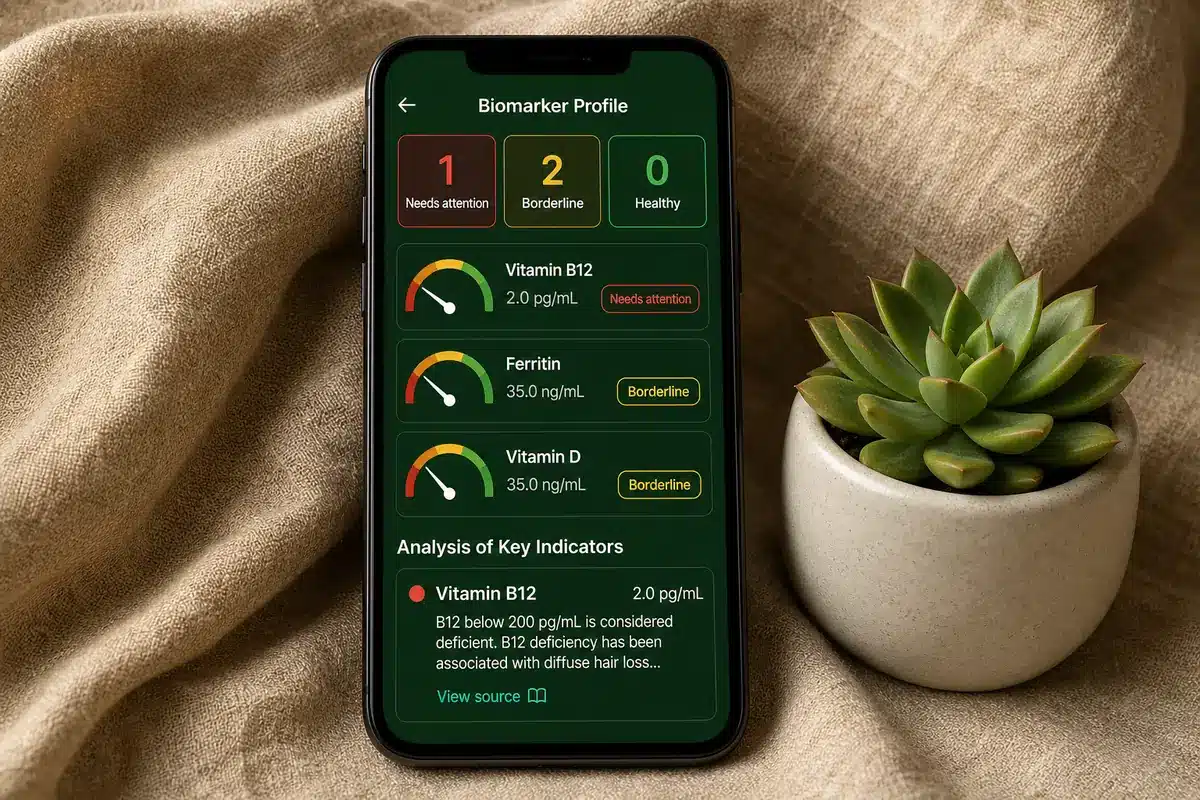
Once entered, each result is placed in a band on your phone against its published range. For each marker you see:
- Where your value sits against the range
- The source for that range
The app describes where a value sits; it does not diagnose. A result outside its range is something to discuss with your GP or dermatologist, who will read it alongside your full health picture.
Blood test results and Scalp Score Pro
Your blood test results are free to enter and do not change your Scalp Score. If you choose Scalp Score Pro, a one-off purchase in Google Play, the AI analysis of your photographs is read with your profile: after you tick the consent box, the names of any markers outside their range go with your answers and photographs. The values themselves are never sent for an analysis.
For markers that can shift over time — ferritin with dietary changes, TSH with thyroid disease progression, vitamin D seasonally — re-testing at intervals your GP suggests gives a fuller picture than a single measurement can.
Taking your results to an appointment
When you see your GP or dermatologist, take the lab report itself. Having your values beside the published ranges helps you ask the questions in this article: which markers sit outside their range, and whether re-testing makes sense.
Where your results are kept
Your blood test results are stored on your phone unless you turn on the backup in the app. The values themselves are never sent for an analysis: if you choose Scalp Score Pro, only the names of any markers outside their range go with it, after you tick the consent box. The privacy policy sets out the detail.
A ferritin result today, followed by another in three months, tells a more useful story than either reading in isolation. Keeping your results in one place means they are to hand when they are most useful: when you are sitting across from the GP or dermatologist who is helping you understand your hair health.
Discuss what your results mean with your GP or dermatologist. Where a value sits beside its range is the starting point for that conversation — not the conclusion, and not a diagnosis.
References
- Trost LB, Bergfeld WF, & Calogeras E. (2006). The diagnosis and treatment of iron deficiency and its potential relationship to hair loss. Journal of the American Academy of Dermatology, 54(5), 824–844. Read study
- van Beek N, Bodó E, Kromminga A, Gáspár E, Meyer K, Zmijewski MA, Slominski A, Wenzel BE, & Paus R. (2008). Thyroid hormones directly alter human hair follicle functions: anagen prolongation and stimulation of both hair matrix keratinocyte proliferation and hair pigmentation. Journal of Clinical Endocrinology & Metabolism, 93(11), 4381–4388. Read study
- Almohanna HM, Ahmed AA, Tsatalis JP, & Tosti A. (2019). The role of vitamins and minerals in hair loss: A review. Dermatology and Therapy, 9(1), 51–70. Read study
- Carmina E, Stanczyk FZ, & Lobo RA. (2019). Evaluation of different laboratory parameters for the diagnosis of polycystic ovary syndrome in lean women. Journal of Clinical Endocrinology & Metabolism, 104(7), 2875–2891. Read study