
There is a particular kind of worry that develops a few months after having a baby. You notice it in the shower first — more hair than usual circling the drain. Then in your hairbrush. Then in the way the light catches your temples differently. You check the mirror and something has changed, though it is difficult to say exactly when it started or how significant it actually is.
You are not imagining it. And in the vast majority of cases, what you are experiencing has a name, a clear biological explanation, and a defined timeline. But that knowledge — genuinely knowing what is happening and what to expect — is harder to come by than it should be. This is that explanation.
What Is Actually Happening
The clinical term is telogen effluvium. It is one of the most common forms of temporary hair loss and one of the most predictable — yet it remains widely misunderstood, even by people who have already searched extensively for answers.1
To understand it, you need to understand the hair growth cycle. At any given time, most of your hair — roughly 85 to 90 per cent — is in the anagen phase: actively growing. The remaining 10 to 15 per cent is in the telogen phase, a resting state that precedes natural shedding. Each strand cycles independently, which is why you lose 50 to 100 hairs per day without noticing any change in overall density.
Telogen effluvium occurs when a physiological trigger — illness, nutritional deficiency, significant physical stress, or hormonal change — causes a large proportion of anagen hairs to shift prematurely into telogen simultaneously. Two to four months later, those hairs shed together. The result is a shedding episode that feels sudden and alarming, but reflects an event that happened weeks before the first hairs appeared in the drain.
Why Pregnancy Changes the Hair Cycle
During pregnancy, elevated oestrogen levels extend the anagen phase across a far larger proportion of your hair follicles than normal.2 This is why many people notice their hair becoming notably thicker and fuller during pregnancy — more follicles than usual are actively growing, and fewer are cycling into their resting phase. It is not that pregnancy creates new hair. It is that the hair you would have naturally shed over those nine months is being retained.
After delivery, oestrogen levels fall sharply — one of the most rapid hormonal shifts the body undergoes at any point in life. This withdrawal signal releases the extended anagen phase, and a substantial proportion of those retained follicles shift into telogen in synchrony.3 The shedding that follows is not hair loss in the clinical sense of follicle damage or permanent recession. It is the belated shedding of hair that was held in place by an elevated hormonal state.
Understanding this distinction matters — not just intellectually, but practically. If what you are experiencing is postpartum telogen effluvium, the follicles are intact. The question is not whether they will grow again, but when, and whether anything is complicating the recovery. For a broader overview of how telogen effluvium, genetic pattern loss, and inflammatory hair loss differ from one another at a mechanistic level, our guide to hair loss causes and stages covers each process in detail.
The Timeline: When Shedding Starts, Peaks, and Resolves
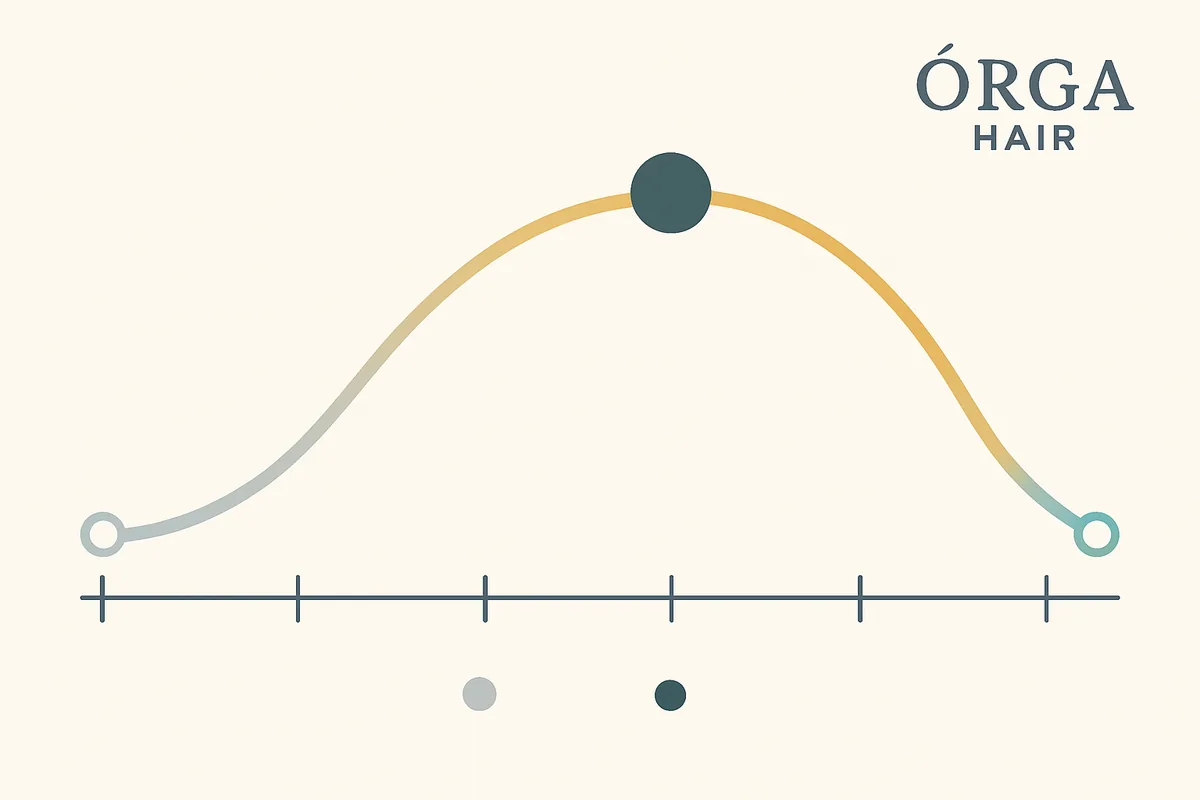
The timing of postpartum telogen effluvium follows a consistent biological pattern. Shedding typically begins between six and sixteen weeks after delivery. It peaks around months three to four postpartum — often at a point where the initial postnatal recovery has settled and the shedding therefore feels unexpected rather than connected to the birth itself.
In the majority of uncomplicated cases, shedding begins to reduce from month four onwards, and density returns toward its pre-pregnancy baseline by month nine to twelve.4 For many people, the resolution is so gradual that it is difficult to identify the turning point — which can itself become a source of anxiety when you are monitoring closely and cannot tell whether things are improving or continuing to worsen.
This is one of the core problems with subjective monitoring during the postpartum period. Counting shed hairs, checking the mirror, comparing photographs taken at different times in different lighting — none of these methods reliably detect the gradual changes that mark the difference between a resolving episode and one that is not following the expected trajectory.
What Makes It Worse
For most people, postpartum telogen effluvium resolves within the expected window without intervention. For others, recovery takes longer or the shedding is more severe — and when that happens, there are usually identifiable contributing factors.
Iron deficiency is the most common. Pregnancy significantly depletes iron stores, and postnatal ferritin levels are not routinely rechecked in many clinical pathways, despite the hair follicle being one of the body’s most nutritionally demanding tissues. Low ferritin — the stored form of iron — is a documented driver of telogen effluvium that is independent of and additive to the hormonal trigger.5 Our article on scalp care habits that make a measurable difference covers how nutritional contributors to hair loss are commonly missed in self-directed care.
Zinc and vitamin D are also commonly depleted in the postpartum period. Both are required for normal hair follicle cycling, and both are further reduced by breastfeeding. Their role in extending or deepening a telogen effluvium episode is well documented, and both are testable through standard blood panels.
Thyroid dysfunction can present postpartum — postpartum thyroiditis affects an estimated five to ten per cent of women — and thyroid-related hair loss can compound or extend an episode of telogen effluvium significantly. If shedding is accompanied by fatigue, temperature sensitivity, or mood changes, thyroid function is worth discussing with your GP as a matter of priority.
Psychological stress is itself a documented modulator of the hair growth cycle. The postnatal period involves significant physical recovery, substantial sleep disruption, and considerable emotional adjustment. These factors can extend the duration of a telogen effluvium episode even after the hormonal trigger has fully resolved.
Is This Normal — Or Is Something Else Happening?
This is the question that most people with postpartum hair loss are actually asking — not “what is this?” but “is mine within normal range, or is it developing into something that requires clinical attention?”
It is a reasonable question, and an honest answer is that it is difficult to answer through self-observation alone. Telogen effluvium and early-stage androgenetic alopecia — genetic pattern thinning — can present similarly in the initial postpartum months, particularly at the frontal hairline and temples. The distinction matters because they have different natural histories: telogen effluvium typically resolves spontaneously; androgenetic alopecia follows a different trajectory and responds to different interventions.
Other conditions can also coincide with the postpartum period: postpartum thyroiditis, iron deficiency anaemia, and early alopecia areata can each present alongside or instead of standard telogen effluvium, with overlapping surface symptoms and distinct clinical trajectories. The reason this matters is covered in depth in our article on why context is everything in hair loss analysis — without a structured clinical picture, the same set of symptoms can point toward several different conditions simultaneously.
What distinguishes them is not how the shedding feels subjectively, but what is measurable. Hair shaft diameter, follicle density, the ratio of miniaturised to terminal follicles, scalp inflammation markers — these are the indicators that separate a resolving telogen episode from a developing condition. They need a GP or dermatologist to assess, not subjective monitoring.
What Useful Tracking Actually Looks Like
The problem with managing postpartum hair loss without a baseline is not a lack of effort. Most people track consciously and carefully — checking the mirror daily, counting shed hairs, photographing their parting when they remember to. The problem is that these observations have no reference point. Without a documented baseline, there is no way to tell whether what you are seeing today represents improvement, deterioration, or normal weekly variation.
Useful tracking means something specific. It means photographs of the same zones — your parting, your temples, your hairline — taken in the same light and from the same angles, so that one month can be compared with the next. It means a short note on each wash day about shedding, itch, sensitivity and flaking, accumulated over weeks and months rather than observed in isolation. And it means keeping your blood test results with their dates.
What that baseline makes possible — and what scattered, unrecorded self-observation cannot replicate — is the ability to see whether your shedding is easing, whether your scalp is settling, and whether the trajectory of your recovery is on course. This is the distinction that matters most during the postpartum period, when the question you most need answered is not “is this happening?” but “is this resolving?”
Scalp Score, the Orga Hair app, is built to help with exactly this. Five short questions give you a free Scalp Score straight away, with no sign-up. The Photo Journal keeps your own photographs in date order so you can compare them side by side, the wash-day check-in keeps your notes, and your blood test results sit beside the published ranges. It does not diagnose, and it cannot tell telogen effluvium apart from pattern thinning; it helps you keep track. Our article on why hair loss progress is so often invisible to the mirror covers the clinical evidence on why early-phase recovery consistently sits below the threshold of visual detection, and what measurement reveals that observation cannot.
When to Seek Clinical Support
Postpartum telogen effluvium that follows the expected timeline — onset within the first four months, gradual reduction from month four, meaningful recovery by month twelve — does not require clinical intervention beyond addressing any nutritional deficiencies identified through blood testing. The follicles are intact, and the biology is resolving on its own schedule.
The signals that warrant professional assessment are: shedding that continues beyond six months with no reduction in rate; recession at the frontal hairline or temples that is progressing rather than diffuse; shedding accompanied by persistent scalp symptoms such as itch, visible scaling, or tenderness; or any concern that the pattern differs meaningfully from what a resolving telogen effluvium episode would predict.
In each of these cases, see a GP or dermatologist. What helps them most is a record: when the shedding began, how it has evolved, what your scalp has looked like over time, which blood tests you have had, and what you have tried. Bringing dated photographs and notes turns an appointment from a starting point into a continuation — from describing what you remember to showing what you recorded.
The One Insight That Changes Everything
The reason postpartum hair loss feels so unresolvable — for so many people who have researched it thoroughly and still feel uncertain — is not lack of information. It is lack of a baseline. You are observing something real without the reference point that would allow you to interpret what you are observing.
That is what changes when you begin tracking consistently. Not the shedding itself, but your relationship to it. For the first time, you know where you stand — dated, structured, specific to you — and you can see, week by week, whether the trajectory is what it should be.
References
- Malkud S. (2015). Telogen Effluvium: A Review. Journal of Clinical and Diagnostic Research, 9(9), WE01–WE03. Read study
- Ohnemus U, Uenalan M, Inzunza J, et al. (2006). The hair follicle as an estrogen target and source. Endocrine Reviews, 27(6), 677–706. Read study
- Lynfield YL. (1960). Effect of pregnancy on the human hair cycle. Journal of Investigative Dermatology, 35(6), 323–327. Read study
- Grover C, & Khurana A. (2013). Telogen effluvium. Indian Journal of Dermatology, Venereology and Leprology, 79(5), 591–603. Read study
- Trost LB, Bergfeld WF, & Calogeras E. (2006). The diagnosis and treatment of iron deficiency and its potential relationship to hair loss. Journal of the American Academy of Dermatology, 54(5), 824–844. Read study
- Blume-Peytavi U, Tosti A, Whiting DA, et al. (2008). Hair Growth and Disorders. Springer Berlin Heidelberg. Read study
- Trüeb RM. (2016). Serum biotin levels in women complaining of hair loss. International Journal of Trichology, 8(2), 73–77. Read study