Most people who are concerned about hair loss are already tracking it. They check the shower drain after every wash. They run fingers through their hair and gauge density by feel. They take photographs when the anxiety peaks. This kind of monitoring is a natural response to a concern you cannot resolve with a single observation.
The problem is that monitoring and tracking are not the same thing. Monitoring tells you that something is happening. Consistent tracking tells you whether it is changing — and in which direction. This distinction is not a technicality. It is the difference between spending months wondering whether things are improving and having a record that shows you, week by week, which way things are moving.
Why Self-Monitoring Consistently Falls Short
The shower drain is the most common self-monitoring tool. It is also one of the least reliable. The number of hairs shed per wash varies significantly based on wash frequency, water temperature, how vigorously you shampoo, and how much you have been shedding between washes. A dramatic drain collection after a delayed wash day tells you nothing clinically meaningful — but it reliably generates significant anxiety.
Photographs are more useful, but only under controlled conditions: consistent lighting, consistent distance, consistent angles, consistent scalp preparation. Casual photographs taken at different times of day, in different rooms, with different levels of scalp tension, are not comparable — even to a trained clinical eye. The comparison you are making between a bathroom photo from Tuesday and a window-light photo from the previous month may be measuring lighting conditions more than scalp condition.
The mirror is the most emotionally salient assessment tool and the most unreliable. The human eye cannot detect early-phase hair density recovery. The same visual threshold that makes significant loss eventually visible also means that gradual restoration is invisible until it crosses a substantial percentage change. As we document in detail in our article on why treatment progress is so often invisible, subclinical follicle activity is consistently occurring at a level that no mirror reveals — and that absence of visible evidence is misread as absence of progress, driving premature treatment discontinuation at exactly the point the intervention was beginning to work.
The Five Things Worth Tracking
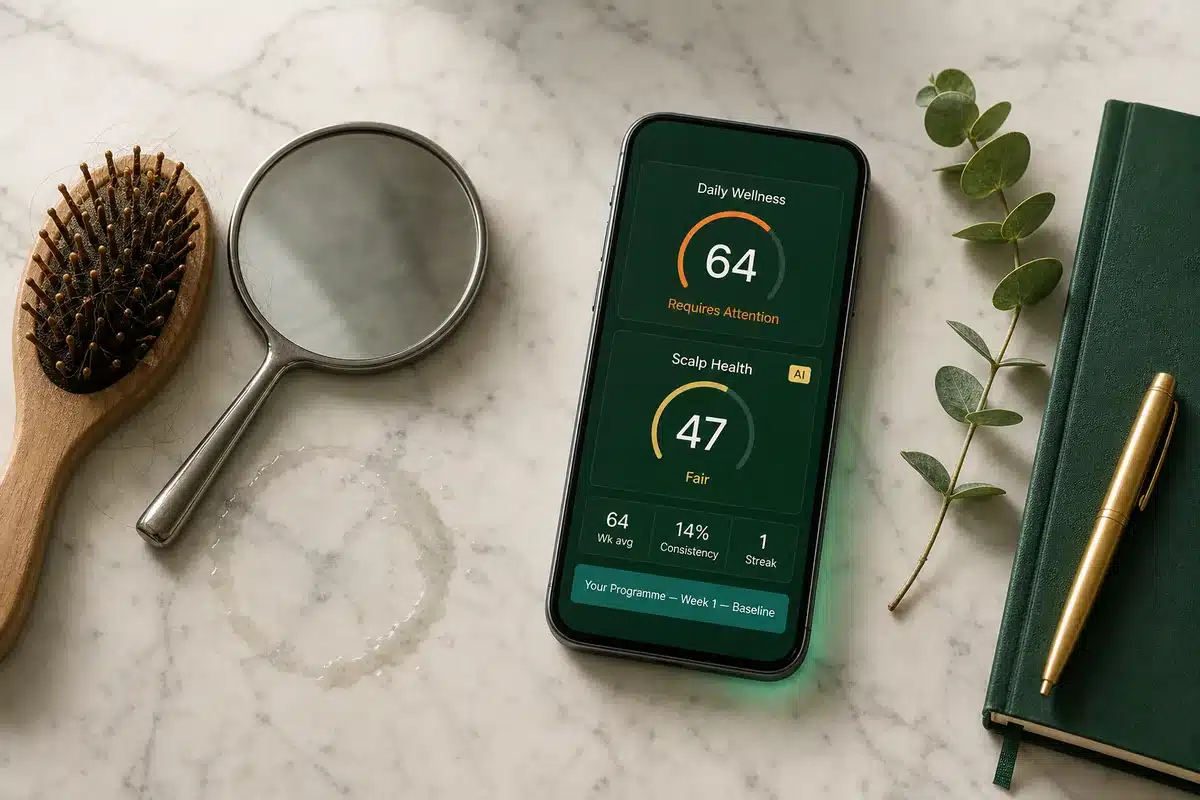
Useful hair loss tracking is built around a defined set of inputs — not passing impressions, but simple ratings that build into a record over time and reveal trends that no single observation could.
Shedding rate is the most obvious input, but requires a consistent context to be meaningful. Same wash frequency, same assessment method, logged daily rather than observed occasionally. A single high-shedding day means nothing. A declining trend across four weeks — even if individual days remain variable — is a meaningful signal.
Scalp itch is a documented early indicator of scalp inflammation, which is itself a driver of conditions including seborrheic dermatitis and early androgenetic alopecia. Consistent itch that precedes visible change is a signal worth capturing. Tracking it from the outset means that if inflammation later becomes relevant to a clinical assessment, you have documented its onset rather than reconstructing it from memory.
Scalp sensitivity — tenderness, discomfort, or pain on touching the scalp — is associated with inflammatory conditions and should be tracked separately from itch. The two indicators can have different clinical associations, and their independent documentation is more useful than a combined “scalp discomfort” metric.
Flaking is an external indicator of scalp condition that is typically managed cosmetically rather than assessed clinically. Tracking its frequency, location, and correlation with product use generates data that is genuinely useful in identifying triggers — and in monitoring whether a treatment protocol is producing measurable scalp condition improvement.
Oil balance — whether the scalp is producing more or less sebum than usual — shifts with hormonal changes, dietary changes, and seasonal variation. These shifts correlate with other indicators in ways that only longitudinal tracking reveals, and they are relevant both to scalp condition assessment and to protocol adjustment.
If any of these symptoms persists, worsens or comes with pain, a GP or dermatologist is the right next step — and a record like this lets the appointment start from a picture of all the contributing factors together, rather than from whichever symptom is most visible that day.
A Photo Protocol That Produces Comparable Evidence
Zone photography is the clinical standard for longitudinal scalp monitoring. Rather than taking general photographs of the overall hair, you identify the zones of concern — typically crown, frontal hairline, temples, and central parting — and photograph those specific zones consistently, from the same angle and at the same distance, on the same day each week.
The value of zone photography is comparison, not observation. A single zone photograph tells you almost nothing in isolation. A series of twelve weekly zone photographs from the same position, taken under consistent lighting, provides a visual record that you, a GP or dermatologist — or an AI analysis — can compare to see whether density, hair calibre, and the scalp surface in that zone look different over the tracking period.
Without protocol consistency, photographs are impressions. With it, they become evidence. The difference is not the quality of the camera. It is the discipline of the method.
Where Scalp Score Fits
Simple ratings and consistent photographs are the foundation. Keeping them together, in order, is what turns them into a record you can actually use — and that is what Scalp Score is built for.
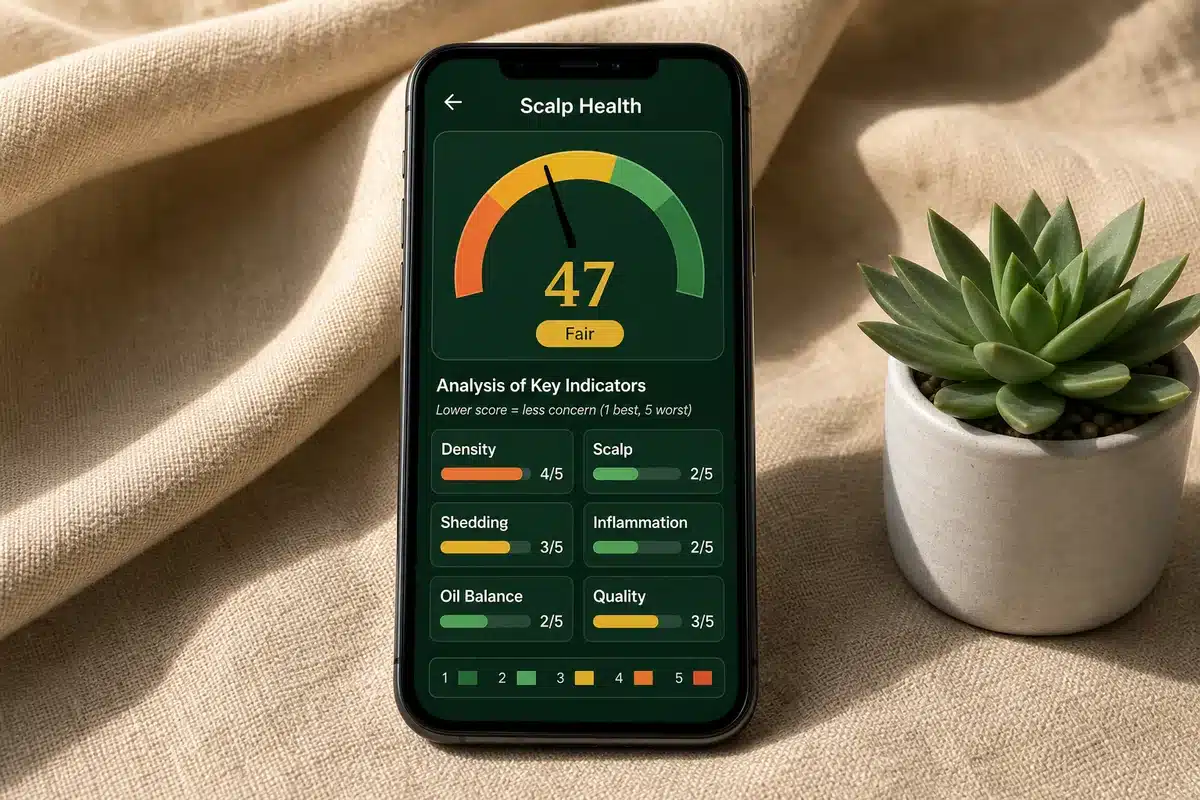
Scalp Score by Orga Hair starts with five short questions. Your score is worked out on your phone straight away, with no sign-up. It is an estimate, not a measurement, and it moves when your answers change — so your score over time is a record of how your own answers have changed. Around it sit free tools for keeping track: a check-in on your wash days, and a Photo Journal that keeps your zone photographs in order and lets you compare them side by side.
When you want to look closer, Scalp Score Pro is a one-off purchase in Google Play. An AI analysis reads the photographs your answers call for — normally two or three scalp zones — together with your profile, and describes what they show in a five-part report: Today, Where, Why, Plan and Watch. It also says what it could not assess. Your reports stay with your account, so a later one sits beside an earlier one. Our explainer on how the AI analysis works covers what happens to your photographs and answers.
The risks of managing hair loss treatment without a structured baseline are documented in depth in our article on self-treating female hair loss.
What Progress Actually Looks Like When You Keep a Record
This is where consistent tracking changes the experience of managing hair loss. The difference between a single observation and a run of them is the difference between a reading and a story. One photograph or one bad week in isolation needs interpretation — is this good, or concerning? But eight weeks of consistent notes across all five indicators, weekly zone photographs of the crown taken the same way each time, and a shedding trend that peaked at week four and has eased since — that is a picture you can take to a GP or dermatologist. It helps answer the question that casual checking cannot: is this working?
The clinical evidence is consistent on this point. Trichoscopic imaging can detect subclinical changes in follicle miniaturisation and hair shaft diameter weeks before those changes produce any visible density difference at the surface level.1 The absence of visible improvement is not evidence that nothing is changing. As documented in our analysis of why running multiple treatments without a baseline leaves you knowing nothing, the measurement gap is not an inconvenience — it is the primary reason that people discontinue effective treatments at exactly the point they were beginning to produce subclinical results.
When Tracking Reveals a Problem Rather Than Confirms Progress
Not every tracking journey confirms a positive trajectory. Sometimes consistent measurement reveals that a condition is not resolving on the expected timeline — that density indicators are declining despite protocol adherence, or that shedding rates are not following the curve the underlying cause would predict.
This is also clinically valuable. A structured longitudinal record that documents a worsening trajectory — with daily symptom logs, zone photographs, and scored indicators to evidence it — gives a GP or dermatologist exactly what a single appointment cannot provide — and a worsening trend is the time to see one. You arrive not with a history of your symptoms from memory, but with documented evidence of them across time.
That transformation of the clinical appointment — from patient describing their experience to patient presenting a structured record of it — is one of the most useful things a consistent record makes possible.
References
- Rudnicka L, Olszewska M, Rakowska A, et al. (2008). Trichoscopy: a new method for diagnosing hair loss. Journal of Drugs in Dermatology, 7(7), 651–654. Read study
- Olsen EA, Messenger AG, Shapiro J, et al. (2005). Evaluation and treatment of male and female pattern hair loss. Journal of the American Academy of Dermatology, 52(2), 301–311. Read study
- Rakowska A, Slowinska M, Kowalska-Oledzka E, et al. (2009). Dermoscopy in female androgenic alopecia: method standardization and diagnostic criteria. International Journal of Trichology, 1(2), 123–130. Read study
- Blume-Peytavi U, & Tosti A. (2011). Hair quality assessment: methods for clinical evaluation. International Journal of Trichology, 3(1), 1–12. Read study
- Trüeb RM, & Rezende HD. (2016). Why Does Hair Loss Occur? International Journal of Trichology, 8(1), 1–5. Read study