The Concern Is Valid — Just Misapplied
A doctor making the rounds on health technology media recently made a point worth engaging with seriously: AI, he warned, can get things dangerously wrong without proper clinical context. He’s absolutely right.
But the concern, valid as it is, applies to a specific kind of AI — the kind that receives an unstructured question from someone describing their symptoms in their own words, and returns a confident-sounding answer with no mechanism for knowing what information it hasn’t been given.
That concern does not apply equally to all AI health tools. The difference between a chatbot and a structured AI system isn’t one of degree. It’s architectural. And nowhere does that architectural difference matter more than in the analysis of hair loss and scalp health — a domain where the same visual presentation can have a dozen fundamentally different causes, each requiring a different clinical response.
This is why Scalp Score, the Orga Hair app, is built the way it is. This article explains what that means.
The Core Problem: AI Working Blind
To understand why context is architecturally critical, it helps to look at what happens when it’s absent.
A landmark 2024 study published in Nature Medicine evaluated current large language models in a simulated clinical setting using 2,400 real patient cases. The findings were unambiguous: LLMs performed significantly worse than physicians at clinical diagnosis, and critically, their performance degraded further still when they were required to gather clinical information themselves rather than receive it in structured form.1
The researchers concluded that without extensive physician supervision, autonomous AI “would reduce the quality of care that patients receive.” The paper’s most salient finding for our purposes: the information-gathering failure is not a secondary issue. It is the primary failure mode.
This is precisely what happens when someone types “I’m losing my hair” into a general-purpose AI chatbot. The AI has no mechanism to ask whether they started a new medication three months ago. It doesn’t know their thyroid has been flagged. It cannot see their scalp. It reasons entirely from the words it receives — and as a large-scale review published in npj Artificial Intelligence noted: “Most studies implicitly assume that the available patient information is sufficient for diagnosis, which often fails, especially in initial consultations or with complex diseases, increasing the risk of misdiagnosis.”2
Why Hair Loss Is Precisely the Wrong Domain for Unstructured AI
Hair loss appears deceptively simple from the outside. It is not.
The same visual presentation — diffuse thinning across the crown — can be caused by androgenetic alopecia, telogen effluvium triggered by a thyroid imbalance, drug-induced alopecia from a medication started months earlier, nutritional deficiency, or a combination of several of these simultaneously. Identical scalp images can point in entirely different clinical directions depending on information the image itself cannot convey.
The medication history problem
This is not a theoretical concern. A 2025 large-scale pharmacovigilance study published in Frontiers in Pharmacology, drawing on the FDA’s Adverse Events Reporting System, identified 64 drugs with significant alopecia signals — and found that 23.4% of them did not list hair loss as an adverse reaction in their official U.S. prescribing information.3 That gap means patients experiencing drug-induced hair loss may have no reason to connect their shedding to their medication — and any AI system receiving only their description of the shedding has no way to either.
The timing problem compounds this further. As the Journal of the American Academy of Dermatology notes in its clinical guidance on drug-induced alopecia, the diagnosis requires verifying the temporal relationship between drug initiation and onset of hair loss.4 Telogen effluvium — the most common form of drug-induced hair loss — becomes clinically apparent only after a latency period of two to four months following the causative agent’s initiation.3 A person who started a new medication in January may not notice significant shedding until March or April. Without a timestamped record of both events, that connection is invisible — to the patient, to a chatbot, and to any AI system operating on a single snapshot.
The thyroid intersection
The clinical picture is further complicated by thyroid status, which can drive hair loss in ways that look visually similar to androgenetic alopecia but respond to entirely different interventions. Both hypothyroidism and hyperthyroidism are associated with diffuse hair loss, with different textural presentations.5 The co-occurrence of thyroid dysfunction and androgenetic alopecia is clinically documented, and when both are present simultaneously, the resulting hair loss pattern can differ substantially from either condition alone.5
Critically, as clinical research has established, thyroid-related hair loss does not respond to DHT-blocking treatments such as finasteride — meaning a recommendation appropriate for androgenetic alopecia may be actively inappropriate for someone whose hair loss is thyroid-driven.5 An AI system that doesn’t know about thyroid history cannot make this distinction. An AI system that receives structured information on thyroid status, current medications, and onset timing at least has that information to work with.
The Architectural Solution: Context First
Scalp Score does not begin with AI analysis. It begins with your answers — and that ordering is the entire point.
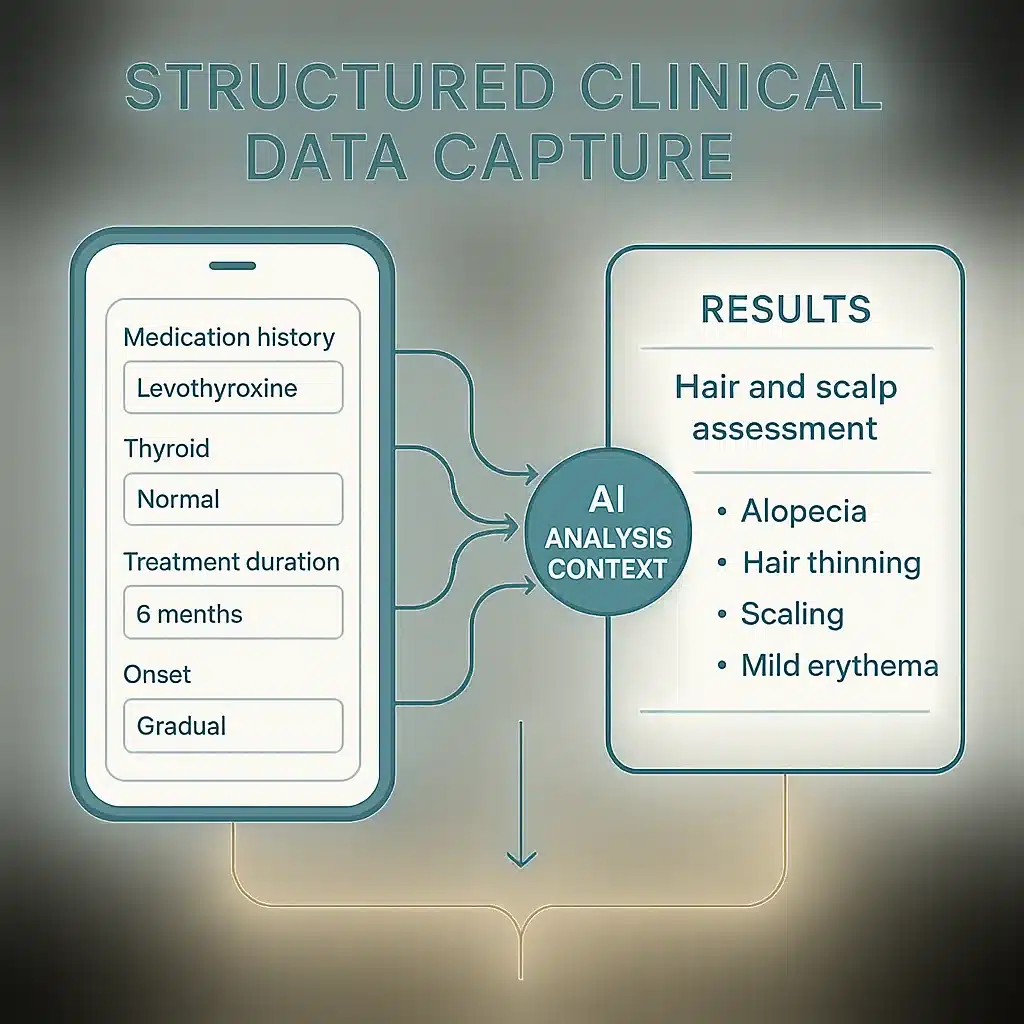
Before Scalp Score Pro reads a single photograph, the app’s profile questions — answered at your own pace — gather the context the analysis needs:
- Current and recent medications, including hair loss treatments (minoxidil, finasteride, peptide serums), hormonal contraceptives, thyroid medications, antidepressants, and anticoagulants
- Known thyroid status and any recent hormonal changes
- Duration of shedding and its temporal relationship to any life changes or new treatments
- Treatment history — including what has been tried and for how long
- Photographs of the scalp zones your answers call for, taken with your own phone
This is not a cosmetic feature. It is how the analysis gets its context. A 2025 scoping review published in the Journal of Medical Internet Research — covering 24 AI technologies applied to medical questionnaires — found that structured AI intake systems have significant potential to improve diagnostic efficiency and support earlier and more accurate clinical intervention precisely because they force completeness that unstructured interaction cannot guarantee.6
The key insight from that research is straightforward: adaptive, structured questioning captures information that patients would not spontaneously volunteer, because patients don’t know what’s clinically relevant. A person experiencing telogen effluvium three months after starting a new blood pressure medication is unlikely to mention the medication unless directly asked. The questionnaire asks. The chatbot does not.
The Longitudinal Dimension: Tracking Change Over Time
A single clinical assessment captures a moment. Hair loss is a process. The difference between those two things is where most consumer-facing AI health tools fail most completely.
Scalp Score is designed to help you keep track of change over time — a Photo Journal of your own photographs with side-by-side compare, wash-day check-ins, when you started a medication, and your score over time. This matters for two reasons.
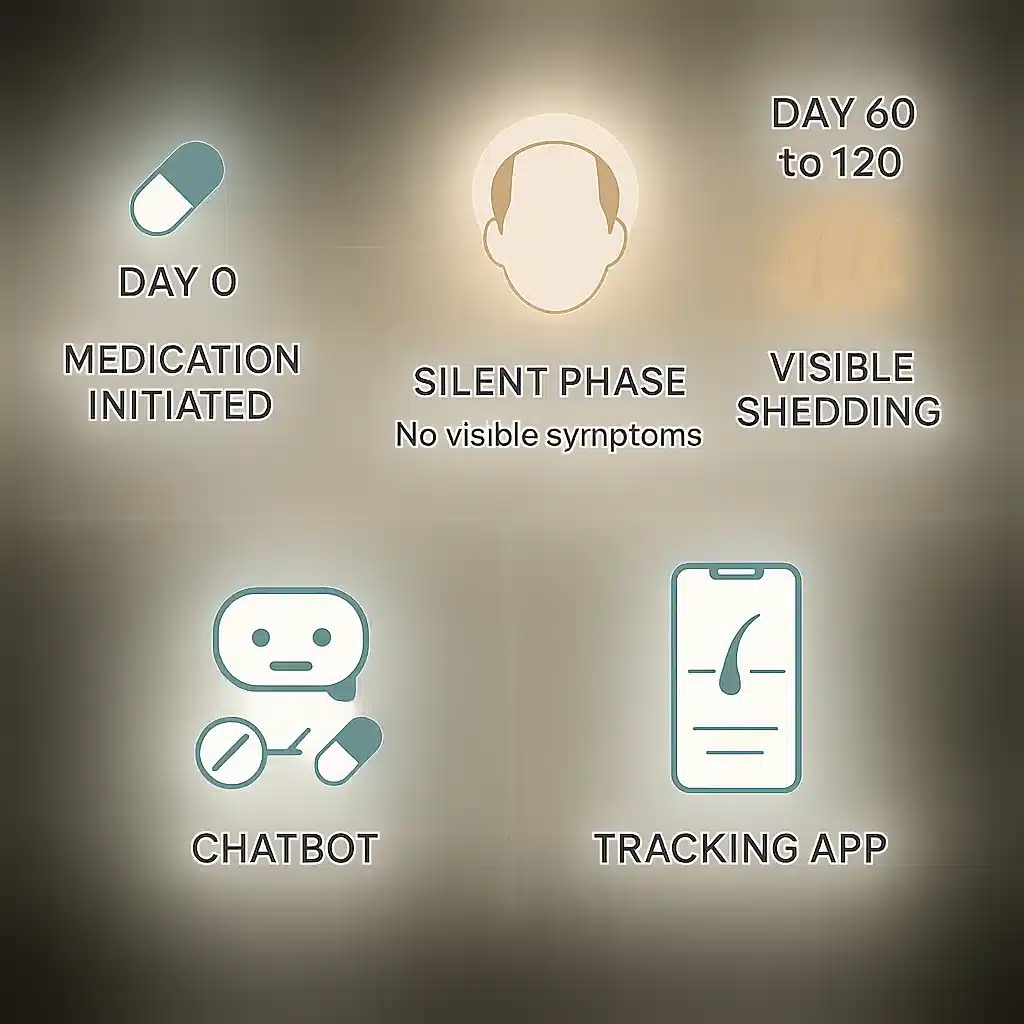
First, it creates a timestamped record of progression or regression, which is precisely the kind of data the Frontiers in Pharmacology study identifies as essential for establishing the temporal relationship between drug initiation and onset of hair loss.3 Someone who starts a new medication, keeps photographing their scalp, and notices increased shedding two or three months later has a dated record of both — a connection a single snapshot could never show.
Second, longitudinal digital health monitoring has a documented record of improving outcomes in conditions requiring continuous management. Research published in npj Digital Medicine studying 16,797 patients enrolled in a digital health management system found significantly reduced adverse outcomes compared to conventional episodic care — a finding that the researchers attributed specifically to the “sustained longitudinal care continuum” that digital monitoring enables.7
Hair loss is precisely this kind of condition. It does not resolve in a single visit. It changes over weeks and months. That is why keeping track in Scalp Score — the Photo Journal, the check-ins, your score over time — is free, not a paid extra.
What the App Won’t Do
Structured context and longitudinal tracking give the AI more to reason over. But there is a separate architectural question: what is the AI permitted to output?
In Scalp Score, some things are kept out of the AI’s hands altogether and handled by fixed rules on your phone instead:
- Your Scalp Score is worked out on your phone by fixed rules, never by the AI; a report can change it only through rules a person has reviewed, by at most one band per part
- Safety messages come from a separate set of rules, on what you report, never on a photograph, and point you to a GP or dermatologist
- Products on a routine step are cosmetics (and, in Poland, over-the-counter pharmacy products), never prescription products
What Scalp Score Pro does produce is a report in five parts — Today, Where, Why, Plan and Watch — that describes what your photographs and answers show, sits beside your earlier reports, and says what it could not assess.
The framing is deliberate: a description, not a diagnosis; what supports your scalp, not a prescription.
Where a Doctor Comes In
There is a practical dimension to all of this that often gets overlooked in the AI-in-healthcare debate: most people experiencing hair loss do not have immediate access to a dermatologist.
Appointment waiting times vary. The cost of repeat consultations is a barrier. And perhaps most importantly, the quality of information a patient can bring to a specialist appointment is often poor — vague descriptions of when things started, uncertain recollections of medications, no visual record of how scalp state has changed.
Scalp Score helps with this last problem. Weeks of check-ins and Photo Journal photographs give you dates, your own photographs and your medication history to take to a GP or dermatologist — rather than starting from scratch with “I’ve been losing my hair for a while.”
The app doesn’t replace a doctor. It helps you keep track, so you arrive with more than a memory.
The Bottom Line
The doctor who raised concerns about AI in healthcare was identifying a real and important problem. Context-free AI, applied to complex clinical questions, can produce plausible-sounding outputs that are clinically wrong — and in health contexts, that matters.
But the solution to bad AI is not no AI. It is AI designed with the clinical inputs, structural constraints, and epistemic humility that the domain demands.
Scalp Score was built with that concern at its centre. The answers come first, to address the context problem. The check-ins and the Photo Journal exist to help with the temporal problem. The fixed rules for the score and the safety messages exist to address the boundary problem. And the plain statement that the app is educational and does not replace a doctor’s advice exists to address the accountability problem.
The concern, in other words, is not just acknowledged. It is the specification from which the system was designed.
References
- Kanjee, Z., et al. (2024). Evaluation and mitigation of the limitations of large language models in clinical decision-making. Nature Medicine, 30, 2613–2622. Read study
- Liu, S., et al. (2025). Large language models for disease diagnosis: a scoping review. npj Artificial Intelligence, 2, 11. Read study
- Wen, Y., et al. (2025). Real-world pharmacovigilance insights into drug-induced risk of alopecia. Frontiers in Pharmacology, 16, 1703423. Read study
- Alhanshali, L., et al. (2023). Medication-induced hair loss: an update. Journal of the American Academy of Dermatology, Supplement. Read study
- Vincent, M., & Yogiraj, K. (2013). A descriptive study of alopecia patterns and their relation to thyroid dysfunction. International Journal of Trichology, 5(1), 57–60. Read study
- Liu, Z., et al. (2025). AI in medical questionnaires: scoping review. Journal of Medical Internet Research, 27, e72398. Read study
- Zhao, K., et al. (2025). Effectiveness of digital healthcare to improve clinical outcomes in discharged patients with coronary artery disease. npj Digital Medicine, 8, 372. Read study