The Thing Nobody Tells You About Hair Loss
If you’ve noticed your hair thinning — a wider parting, less density at the crown, more hair than usual on the shower floor — you’ve probably also experienced the helplessness that follows.
You search online and get overwhelmed with conflicting information. You mention it to your GP and come away with a blood test referral but no real answers. You try a few products, see no difference, and end up more frustrated than before.
Here’s what that experience reflects: hair loss is genuinely complex, it has multiple distinct causes, and the same symptom (hair falling out, getting thinner) can stem from completely different underlying processes. Treating the wrong cause, or treating the symptom rather than the cause, is why so many people spend years cycling through products and protocols that don’t work.
This article explains the main causes of hair loss in plain language — what they are, how they develop, and what the evidence says about each.
The Most Common Cause: Genetic Pattern Hair Loss
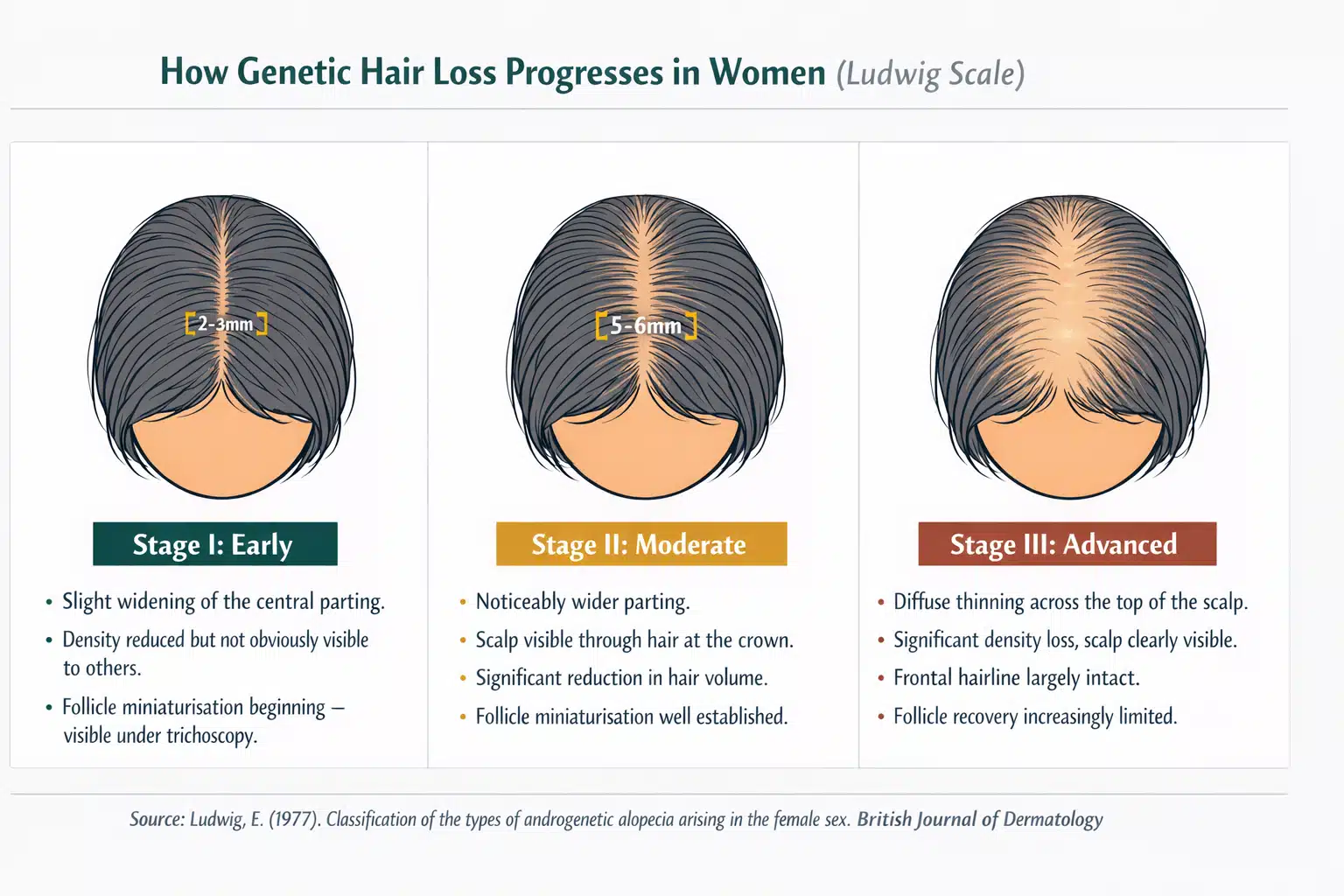
The most widespread form of hair loss in both men and women is driven by a combination of genetics and hormones. In men, the pattern typically begins at the temples and crown — the classic receding hairline shape. In women, the process is different: rather than a receding hairline, there’s a gradual widening of the central parting and a reduction in density across the top of the scalp, while the frontal hairline remains largely intact.1
The underlying mechanism involves a hormone called dihydrotestosterone (DHT). In people with a genetic sensitivity to it, DHT causes hair follicles to gradually miniaturise — producing finer, shorter hairs with each cycle until eventually the follicle stops producing visible hair altogether.2
This process doesn’t happen overnight. It progresses through measurable stages, and the earlier it is identified, the more options are available.
The Second Most Common Cause: Temporary Shedding
Telogen effluvium is a mouthful of a name for something most people have experienced without knowing it. It describes a sudden increase in hair shedding that occurs when a large number of hair follicles simultaneously shift from the growth phase into the resting and shedding phase — usually in response to a significant physical or psychological stressor.3
Common triggers include:
- Prolonged intense stress (work, relationships, grief)
- Illness, surgery, or high fever
- Crash dieting or significant rapid weight loss
- Iron or protein deficiency
- Childbirth (postpartum shedding)
- Starting or stopping certain medications
The shedding typically begins two to four months after the triggering event — which is why people often can’t connect the dots. The hair loss feels sudden, but it’s actually a delayed response.
The good news: in most cases, telogen effluvium is temporary. Once the trigger is resolved and any nutritional deficiencies are addressed, the growth cycle restores itself over six to twelve months.3 The important caveat is that if telogen effluvium is occurring on top of genetic pattern loss, the underlying loss becomes more visible and recovery feels slower.
The Third Factor: Scalp Inflammation and Bacterial Imbalance
This is the cause that gets the least attention in mainstream hair loss discussions — and it may be the most important one to address first.
Chronic scalp inflammation, driven partly by an imbalance in the scalp’s natural bacterial microbiome, creates an environment that is actively hostile to healthy hair growth. Elevated levels of bacterial activity (visible under UV trichoscopy as porphyrin deposits) produce inflammatory signals that disrupt the follicle environment, impair the normal hair growth cycle, and — over time — contribute to follicle miniaturisation even in people without a strong genetic predisposition to hair loss.4
This type of hair loss often comes with other scalp symptoms: sensitivity, itching, a feeling of tension or burning, or persistent low-grade irritation that doesn’t respond to standard anti-dandruff products.
Chemical treatments — hair colouring, perming, relaxing — on a significantly inflamed scalp can make matters worse. The compromised barrier function of an inflamed scalp lets chemical agents penetrate more readily, which can worsen the inflammation further.
The Role of Menopause and Hormonal Shifts
For women, the hormonal changes of perimenopause and menopause represent one of the most significant drivers of hair thinning — and one of the most under-discussed.
Oestrogen plays a protective role in hair growth: it prolongs the growth phase and partially counteracts the miniaturising effects of DHT. As oestrogen levels decline during menopause, this protective effect reduces, and genetic hair loss (if present) often accelerates noticeably.5
At the same time, declining oestrogen also affects scalp health more broadly — skin becomes drier, barrier function weakens, and the inflammatory response can intensify. Women in menopause who are also dealing with chronic stress and possible iron deficiency are managing multiple compounding factors simultaneously.
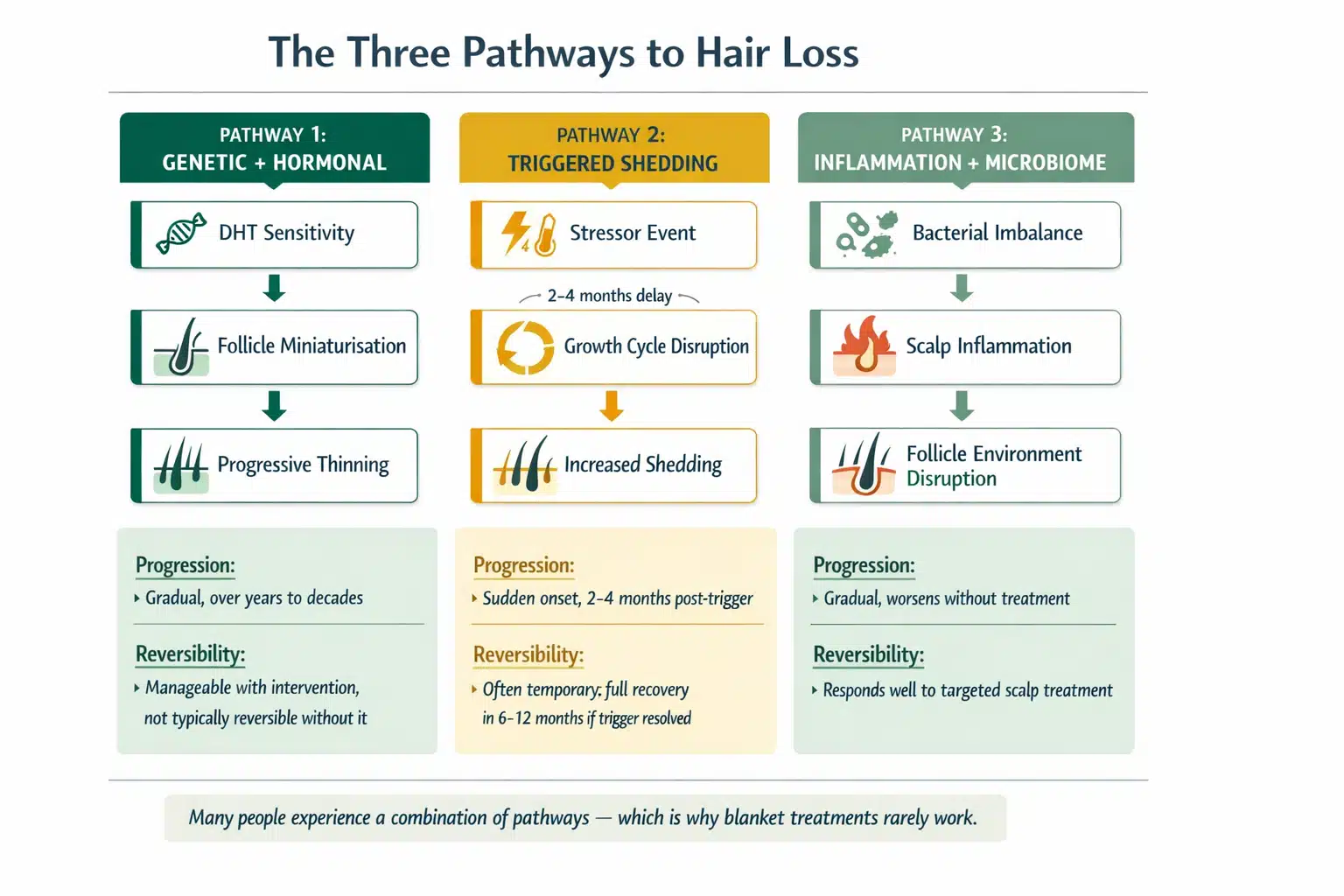
This layered picture is exactly why a blanket approach — one product, one supplement — rarely works. Understanding which factors are active means looking at the whole picture: your health, your history and your scalp.
What You Can Actually Do
Get clarity on the cause first
The single most impactful thing is understanding which process is driving your hair loss. Blood tests from your GP (specifically ferritin, thyroid, and hormonal panels) address the systemic causes. A GP or dermatologist can also look at the scalp itself, often with trichoscopy (a magnified view of the scalp and hair), for signs of inflammation, reduced density and miniaturisation.
Address inflammation before anything else
If scalp inflammation and bacterial imbalance are present, these need to be the first priority — before any stimulatory treatments, and certainly before any chemical processing. Introducing stimulatory agents to an inflamed scalp is counterproductive.4
Support the growth environment nutritionally
Ensure ferritin is in a healthy range (not just within the clinical lower limit — hair growth research suggests ferritin below 40 µg/L can impair the growth cycle even when not technically deficient6). Maintain adequate protein. Consider omega-3 supplementation to support sebum quality and reduce scalp inflammation.
Be consistent and patient
Hair growth cycles are three to six months long. Any meaningful response to treatment — whether addressing inflammation, correcting deficiency, or stimulating follicle activity — takes time to manifest as visible improvement. Eight to twelve weeks of consistent treatment is the minimum meaningful assessment window.
The Bottom Line
Hair loss is not one thing. It is multiple possible processes — some genetic, some nutritional, some driven by scalp inflammation, often a combination of all three. The frustration most people experience comes from treating one factor when several are in play.
The starting point is not another product. It’s clarity about what is actually happening.
References
- Ludwig, E. (1977). Classification of the types of androgenetic alopecia (common baldness) arising in the female sex. British Journal of Dermatology, 97(3), 247–254. Read the study
- Sinclair, R. (1998). Male pattern androgenetic alopecia. BMJ, 317(7162), 865–869. Read the study
- Malkud, S. (2015). Telogen Effluvium: A Review. Journal of Clinical and Diagnostic Research, 9(9), WE01–WE03. Read the study
- Polak-Witka, K., et al. (2020). The role of the microbiome in scalp hair follicle biology and disease. Experimental Dermatology, 29(3), 286–294. Read the study
- Mirmirani, P. (2013). Hormonal changes in menopause: do they contribute to a ‘midlife hair crisis’ in women? British Journal of Dermatology, 169(Suppl 3), 2–8. Read the study
- Trost, L.B., Bergfeld, W.F., & Calogeras, E. (2006). The diagnosis and treatment of iron deficiency and its potential relationship to hair loss. Journal of the American Academy of Dermatology, 54(5), 824–844. Read the study